General relativity: gravity as curved spacetime
What general relativity adds to special relativity
Special relativity deals only with observers moving at constant velocity. General relativity extends the idea to accelerating frames — and in doing so reinterprets gravity itself. This standard treats it qualitatively: you need the ideas and the evidence, not the mathematics.
- Special relativity: no experiment can tell you which of two frames in uniform relative motion is "really" moving.
- General relativity: no experiment done inside a sealed box can tell you whether the box is sitting in a gravitational field or accelerating through empty space.
The equivalence principle
This second statement is the equivalence principle, and everything else follows from it.
- Imagine standing in a sealed lift. You feel your weight pressing you to the floor. There are two explanations:
- the lift is at rest on Earth's surface, in a gravitational field of N kg−1, or
- the lift is far from any mass, accelerating upward at m s−2.
- No experiment inside the lift can distinguish them. Drop a ball and it accelerates toward the floor at m s−2 either way.
- Einstein took this indistinguishability to be a statement about reality: a uniform gravitational field and an accelerating frame are the same thing, not merely similar.
Why this means spacetime is curved
- Fire a light beam horizontally across the accelerating lift. In the time the light takes to cross, the lift moves up, so the light strikes the far wall below the point it entered — the beam appears to bend downward.
- By the equivalence principle, the same must happen in a gravitational field: light bends near a mass.
- But light always travels the straightest available path. If a straight path bends, it is not the light that is curved — it is the space and time the light is travelling through.
- Gravity is therefore not a force pulling objects off straight lines. It is the curvature of spacetime, and objects — including light — simply follow the straightest paths available in it.
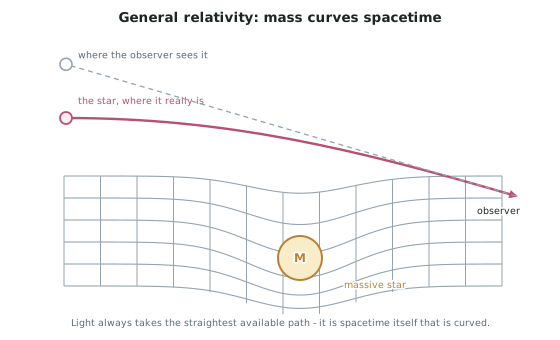
The three classic pieces of evidence
- Gravitational lensing. Light from a distant star passing close to the Sun is deflected. Measured during the 1919 solar eclipse, when stars near the Sun's edge appeared displaced from their known positions by about the predicted amount. Today, whole galaxies act as lenses, producing multiple images and rings.
- Gravitational time dilation. Clocks run slower where the gravitational field is stronger, i.e. deeper in a gravitational well.
- Confirmed by comparing atomic clocks at different altitudes, and by the GPS system: satellite clocks run about microseconds per day faster than clocks on the ground once both relativistic effects are combined. Without correcting for this, GPS positions would drift by around km per day.
- Gravitational waves. Accelerating masses radiate ripples in spacetime itself. First detected directly in 2015 by LIGO, from two merging black holes — the passing wave stretched and squeezed a 4 km detector arm by less than the width of a proton.
Comparing the two theories
| Special relativity | General relativity | |
|---|---|---|
| Applies to | frames in uniform relative motion | accelerating frames and gravity |
| Founding idea | the laws of physics and the speed of light are the same in all inertial frames | a gravitational field is indistinguishable from an accelerating frame |
| Treats gravity? | no | yes — as curvature of spacetime |
| Time dilation caused by | relative speed | gravitational field strength |
| Key evidence | muon decay, particle accelerators | eclipse light-bending, GPS clocks, gravitational waves |
Worked ExampleExplaining the GPS correction
GPS satellites orbit at about km altitude at around km s−1. Their onboard clocks are deliberately adjusted before launch. Explain, using both special and general relativity, why two separate corrections are needed and why they act in opposite directions.
Step 1 — The special-relativistic effect
The satellite is moving relative to the ground at km s−1. Time dilation from relative motion means a moving clock runs slow as seen from the ground. This effect makes the satellite clock lose about microseconds per day.
Step 2 — The general-relativistic effect
The satellite is higher in Earth's gravitational field, where the field is weaker and spacetime is less curved. Clocks run faster where gravity is weaker, so this effect makes the satellite clock gain about microseconds per day.
Step 3 — Combine them
The two act in opposite directions because they arise from different causes — one from relative speed, one from difference in gravitational potential:
Step 4 — Why it matters
GPS finds your position from the time a signal takes to arrive, multiplied by . An error of μs corresponds to
so uncorrected clocks would put your position out by around km after a single day, and the error would accumulate.