Quarks and leptons
What "fundamental" means
Protons and neutrons are not fundamental — they are built from smaller particles. The standard treats this qualitatively: you need the classification and what it explains, not the mathematics.
- A fundamental (or elementary) particle has no internal structure — it is not made of anything smaller.
- All known matter particles fall into exactly two families: quarks and leptons.
Quarks
- Quarks are fundamental particles that feel the strong interaction.
- They carry fractional electric charge, in units of the elementary charge :
| Quark | Symbol | Charge |
|---|---|---|
| up | u | |
| down | d |
- There are six quarks in total (up, down, charm, strange, top, bottom), but ordinary matter needs only up and down.
- Quarks are never found alone. Separating two quarks takes so much energy that new quarks are created instead, so quarks only ever appear bound into composite particles.
- A particle made of three quarks is called a baryon. Protons and neutrons are baryons.
Building the proton and the neutron
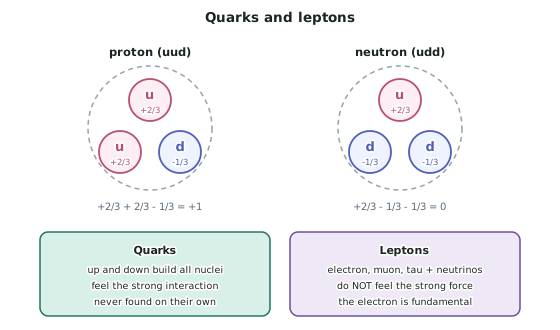
- Proton = uud:
- Neutron = udd:
The charges of the proton and the neutron are therefore not fundamental facts to memorise — they are consequences of which quarks each contains.
Quark 1:
Quark 2:
Quark 3:
Total charge +1e — a proton: the nucleus of ordinary hydrogen. Turn one d into a u and a neutron becomes a proton — that single flavour change is beta-minus decay.
- Switch a single d to a u and a neutron becomes a proton. That one flavour change is beta-minus decay, seen from the inside.
Leptons
- Leptons are fundamental particles that do not feel the strong interaction.
- The electron is a lepton, and it is genuinely fundamental — unlike the proton, it has no internal structure.
- Leptons come in three pairs: the electron, muon and tau, each with its own neutrino.
- Neutrinos are electrically neutral, almost massless, and interact only very weakly — which is why they pass through matter almost undisturbed.
The two families compared
| Quarks | Leptons | |
|---|---|---|
| Feel the strong interaction | yes | no |
| Electric charge | fractional (, ) | whole (, or for neutrinos) |
| Found on their own | never | yes |
| Examples in ordinary matter | up, down | electron, electron neutrino |
What this picture explains
- Why the nucleus holds together. The strong interaction between nucleons is a residual effect of the much stronger force binding quarks inside each nucleon — rather as the forces between neutral molecules are a leftover of the electrical forces inside them.
- Beta-minus decay. A neutron (udd) becomes a proton (uud) when a down quark changes into an up quark, emitting an electron and an antineutrino. Charge is conserved because the quark's charge changes by while an electron of charge is created.
- Why the electron is different. The electron is a lepton, feels no strong force, and is not made of quarks — which is why electrons sit outside the nucleus while quarks are locked inside nucleons.
- Why neutrinos were predicted before they were found. Beta decay appeared to lose energy and momentum; a neutral, nearly massless lepton carrying them away restored both conservation laws.