The strong interaction and Coulombic repulsion
The two forces competing inside a nucleus
A nucleus is a collection of positively charged protons packed into a space around m across. Electrically that should be impossible — the repulsion is enormous. Something stronger must be holding it together.
- The strong interaction (the strong nuclear force) is an attractive force acting between all nucleons — proton–proton, proton–neutron and neutron–neutron alike. It does not care about charge.
- Coulombic repulsion is the electrostatic repulsion between protons, . It acts only between protons, and it never switches off.
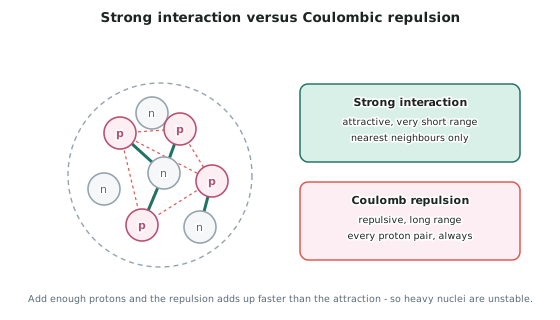
The crucial difference: range
| Strong interaction | Coulombic repulsion | |
|---|---|---|
| Acts between | all nucleons | protons only |
| Direction | attractive | repulsive |
| Range | very short, about m — roughly one nucleon diameter | long range, falling off as |
| Reaches across a large nucleus? | no — nearest neighbours only | yes — every proton pair |
| Relative strength at m | around 100 times stronger | weaker at this separation |
- At very small separations the strong force is much stronger than the electrical repulsion, which is why small nuclei hold together at all.
- Beyond about m the strong force falls away to essentially nothing, while the Coulomb force is still acting.
- The strong interaction also becomes repulsive at extremely short range, which stops nucleons collapsing into one another and sets the size of a nucleus.
Why this explains nuclear stability
- In a small nucleus, every nucleon is within strong-force range of every other, so attraction wins comfortably.
- As a nucleus grows, the number of proton pairs repelling each other grows roughly as the square of the proton number, while strong-force attraction grows only in proportion to the number of nucleons — because each nucleon binds only to its neighbours.
- Repulsion therefore accumulates faster than attraction as nuclei get larger. Beyond bismuth-209 () no nucleus is stable.
- Adding neutrons helps: they contribute strong-force attraction without adding any repulsion. This is why stable heavy nuclei have far more neutrons than protons — around 1.5 neutrons per proton for lead, versus 1 for carbon.
Connecting to binding energy
- Because nucleons attract each other, energy must be supplied to pull a nucleus apart — that energy is the binding energy.
- The balance between the two forces is exactly what the binding energy per nucleon curve records:
- Rising at low mass number, because each added nucleon gains more neighbours within range.
- Peaking near iron-56, the most tightly bound nucleus.
- Falling at high mass number, because accumulated Coulomb repulsion between an ever-larger number of proton pairs steadily erodes the binding.
- That falling tail is why fission of heavy nuclei releases energy, and the rising part is why fusion of light nuclei does.
Worked ExampleExplaining why there is a heaviest stable nucleus
Explain why no nucleus heavier than bismuth-209 is stable, referring to both forces acting in the nucleus and to how each scales as the nucleus grows.
Step 1 — How the attraction scales
The strong interaction has a range of about one nucleon diameter, so each nucleon binds only to the handful of nucleons touching it. Adding one more nucleon therefore adds a roughly constant number of new bonds, and the total strong-force binding grows in proportion to the number of nucleons, .
Step 2 — How the repulsion scales
The Coulomb force acts between every pair of protons, at any separation within the nucleus. A nucleus with protons has proton pairs, so the total repulsive energy grows roughly as — much faster than .
Step 3 — Compare the two trends
Attraction grows linearly with size; repulsion grows quadratically. However favourable the balance is for small nuclei, a quadratic term must eventually overtake a linear one.
Step 4 — What adding neutrons achieves, and why it runs out
Extra neutrons add strong-force attraction with no extra repulsion, which is why the stable neutron-to-proton ratio rises from about 1 for light nuclei to about 1.5 for lead. But neutrons cannot be added without limit: a nucleus with too many neutrons for its proton count becomes unstable to beta-minus decay, in which a neutron converts to a proton — restoring the very repulsion the neutrons were added to offset.
Step 5 — Conclude
Beyond there is no neutron-to-proton ratio that satisfies both constraints at once. Every heavier nucleus is unstable, decaying by alpha emission (shedding two protons and two neutrons at a time) or by fission.