Charging, discharging and the time constant
Key ideas
- A capacitor charging or discharging through a resistor changes exponentially — fast at first, then ever slower, because the current depends on how much voltage is still to change.
- The pace is set by the time constant:
- — the time constant (s)
- — the resistance in the charging/discharging path (Ω)
- — the capacitance (F)
- In one time constant:
- a charging capacitor's voltage (and charge) rises to 63% of its final value
- a discharging capacitor's voltage, charge and current all fall to 37% of where they started
- After about 5τ the process is essentially complete.
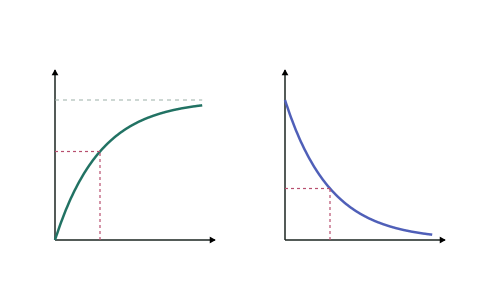
- The graphs (all exponential):
- charging: and rise (63% at ); the current starts maximum and decays — a full capacitor takes no current
- discharging: , and all decay together (37% at )
Why it's exponential
- Early on, the capacitor is empty, the full supply voltage sits across , and the current is large — charge arrives quickly.
- As the capacitor fills, its voltage opposes the supply, less voltage remains across , and the current shrinks.
- Less current → slower charging → the curve flattens. The rate is always proportional to what's left to do.
A µF capacitor charges through a kΩ resistor from a V supply. Find the time constant, and the voltage across the capacitor one time constant after switch-on.
Step 1 — Time constant
Step 2 — Voltage after one time constant (charging → 63%)
Step 3 — Interpret
After s the capacitor is at V; after about s it is effectively full at V.
Tips
- Ask "is this quantity rising or decaying?" before reaching for 63% or 37%. Charging voltage rises (63%); charging current decays (37%); discharging everything decays (37%).
- A bigger or bigger both slow the process — useful for camera flashes (charge slowly, dump quickly through a tiny resistance).
Test yourself
Practice by grade
One question each at Achieved, Merit and Excellence. Have a go, then compare with the model answer.
Achieved
A µF capacitor discharges through a kΩ resistor.
Show that the time constant is s.
Merit
A capacitor charged to V discharges through a resistor with time constant s.
Calculate the voltage after s and after s.
Excellence
Explain why the current in a charging RC circuit is largest at the instant of switch-on and then decreases, and why the capacitor's voltage–time graph has its steepest slope at the start.