Charging and discharging: RC circuits
Charging a capacitor through a resistor
When a capacitor is connected through a resistor to a supply of voltage :
- At the instant of connection ():
- the capacitor is uncharged, so ,
- the full supply voltage appears across the resistor,
- the current is therefore at its maximum, .
- As charging proceeds:
- charge accumulates, so rises,
- less voltage remains across the resistor, so the current falls,
- the falling current means charge accumulates more slowly — which is why the curves are exponential rather than straight.
- After a long time ():
- and the capacitor is fully charged,
- the current falls to zero, and no more charge flows.
The shapes of the three graphs
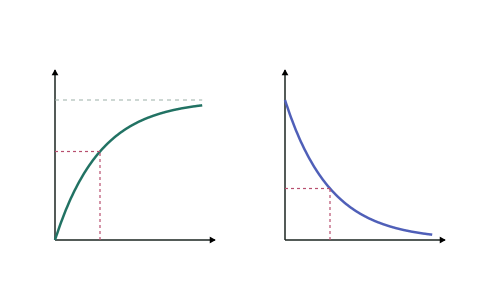
| Quantity | Charging | Discharging |
|---|---|---|
| Charge | rises from 0, levelling off at | falls from toward 0 |
| Voltage | rises from 0, levelling off at | falls from toward 0 |
| Current | falls from toward 0 | falls from toward 0, in the opposite direction |
- Note that the current decays in both cases — this catches people out. During discharge the current flows the other way, but its magnitude still falls from a maximum toward zero.
- and always have the same shape, because with constant.
- The curves approach their final values asymptotically — strictly they never quite arrive.
Watch the three curves develop together below, and change and to see the timescale stretch and shrink:
τ = RC = 2.0 s
After one time constant τ, the capacitor has charged to 63% of the supply.
The time constant
-
— the time constant (seconds)
-
— resistance (Ω), — capacitance (F)
-
Check the units: (Ω)(F) seconds. If your answer is not in seconds, a prefix has been missed.
-
The time constant is the single number that sets the timescale of the whole process. It does not change during charging or discharging.
What means:
- Charging: after one time constant the capacitor has reached of its final charge and voltage.
- Discharging: after one time constant the charge and voltage have fallen to of their initial values.
- The current, which always decays, falls to of its initial value after one in both cases.
| Time elapsed | Charging (% of final) | Discharging (% of initial) |
|---|---|---|
| 63% | 37% | |
| 86% | 14% | |
| 95% | 5% | |
| 99% | 1% |
- A capacitor is usually treated as fully charged or discharged after about .
Finding the time constant from a graph
- From a discharge curve: find the time at which the value has fallen to of its initial value. That time is .
- From a charging curve: find the time to reach of the final value.
- Using the initial gradient: the tangent to the curve at , extended, meets the final value at . This is often more accurate than reading a percentage off a flattening curve.
What changes the timescale
- Larger → larger → slower charging, because the resistor limits the current.
- Larger → larger → slower charging, because more charge is needed to reach a given voltage.
- The final charge and voltage depend on and but not on . Changing the resistor changes how fast, never how much.
Worked ExampleTime constant and charging
A µF capacitor is charged through a kΩ resistor from a V supply. Find the time constant, the initial current, the final charge, and the voltage across the capacitor after one time constant.
Step 1 — Time constant
Step 2 — Initial current
At the capacitor is uncharged, so the whole supply voltage is across the resistor:
Step 3 — Final charge
When fully charged the capacitor has the full supply voltage across it:
Step 4 — Voltage after one time constant
After the capacitor has reached of its final voltage:
Worked ExampleReading a time constant from a discharge graph
A capacitor discharging through a resistor has an initial voltage of V. A graph shows the voltage has fallen to V after s. Determine the time constant, and estimate the voltage after s.
Step 1 — Express the voltage as a fraction of the initial value
Step 2 — Recognise the value
is precisely the fraction remaining after one time constant. So:
Step 3 — Voltage after 9.0 s
After three time constants, of the initial value remains:
Worked ExampleComparing two circuits
Two identical µF capacitors are charged from the same V supply, one through a kΩ resistor and one through a kΩ resistor. Compare the time constants, the initial currents, and the final charges.
Step 1 — Time constants
The second circuit charges five times more slowly.
Step 2 — Initial currents
The larger resistor allows one fifth of the initial current.
Step 3 — Final charges
Identical for both — the resistance does not appear.