Translated conics and converting from general form
Translating a conic
- Any conic can be moved (translated) so its centre or vertex sits at instead of the origin.
- Replace with and with in the standard equation.
- The shape and size stay the same — only the position changes.
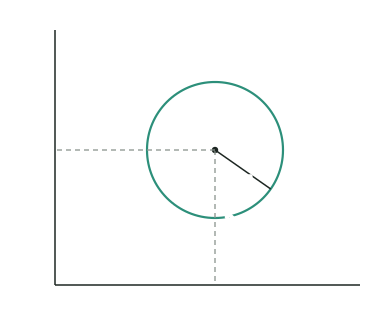
The translated standard forms
- Circle: .
- Ellipse: .
- Hyperbola: .
- Parabola: (opening right from vertex ).
- In every case the centre or vertex is at .
Locating features after a translation
- Find the feature at the origin first (centre, foci, vertices, directrix), using , , .
- Then shift each feature by .
- Example: if a focus sits at before translating, after translating it is at .
Converting general form to standard form
- A translated conic is often expanded into a general second-degree equation.
- Group the -terms and the -terms.
- Complete the square in and in (the same method as for the circle).
- Divide through if needed so the right-hand side is (for an ellipse or hyperbola).
Write in standard form and state its centre.
Step 1 — Group and factor out the leading coefficients
Step 2 — Complete the square inside each bracket
Half of is (square ); half of is (square ). Add inside, balancing outside:
Step 3 — Divide through by to get ""
Step 4 — Read off the centre
Test yourself
Practice by grade
One question each at Achieved, Merit and Excellence. Have a go, then compare with the model answer.
Achieved
State the centre and radius of the circle , and the coordinates of the point on it directly to the right of the centre.
Merit
By completing the square, write in standard form, then state its centre, radius, and the coordinates of the highest point on the circle.
Excellence
The ellipse models the boundary of a skateboard bowl (metres). Find the coordinates of its foci, and explain how you located them from the translated equation.