The ellipse: standard form, axes and foci
What an ellipse is
- An ellipse is the set of points for which the sum of the distances to two fixed points is constant.
- The two fixed points are the foci (singular: focus).
- It looks like a stretched circle — a circle is the special case where the two foci coincide.
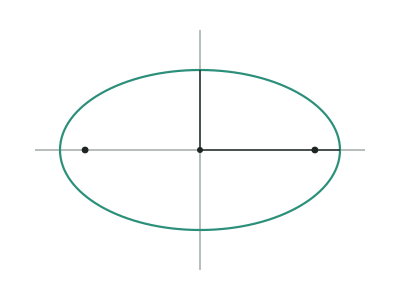
Standard form centred at the origin
- An ellipse centred at the origin has equation:
- — the semi-major axis (half the longer diameter) when .
- — the semi-minor axis (half the shorter diameter).
- The major axis lies along the axis of the larger denominator.
- If the ellipse is wider than it is tall, with the major axis on the -axis.
Vertices and axes
- Vertices on the major axis: (for ).
- Co-vertices on the minor axis: .
- The major axis has length ; the minor axis has length .
Finding the foci
- The foci lie on the major axis, at (for ).
- Find from:
- — the distance from the centre to each focus.
- Note the subtraction: for an ellipse is always smaller than .
Eccentricity
- The eccentricity measures how "stretched" the ellipse is:
- near — almost a circle.
- near — long and thin.
For the ellipse , find the lengths of the major and minor axes, the coordinates of the foci, and the eccentricity.
Step 1 — Identify and
The larger denominator is , so , , giving and . The major axis is horizontal.
Step 2 — Axis lengths
Step 3 — Find the foci with
The foci lie on the major (horizontal) axis:
Step 4 — Eccentricity
Test yourself
Practice by grade
One question each at Achieved, Merit and Excellence. Have a go, then compare with the model answer.
For the ellipse , write down the coordinates of the four vertices (endpoints of the axes).
An ellipse has equation . Find the coordinates of its foci and its eccentricity.
The elliptical garden bed at a NZ botanic garden is m long and m wide. Two sprinkler heads are placed at the foci. Find, as an exact value, how far apart the sprinklers should be, and explain what happens to that distance if the bed is made narrower while keeping the same length.