The hyperbola: standard form, foci and asymptotes
What a hyperbola is
- A hyperbola is the set of points for which the difference of the distances to two fixed points is constant.
- The two fixed points are the foci.
- It has two separate branches that open away from each other.
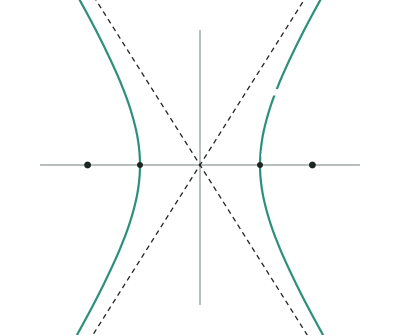
Standard form opening left and right
- A hyperbola centred at the origin opening left–right has equation:
- — the distance from the centre to each vertex.
- The vertices are at .
- The minus sign is what distinguishes the hyperbola from the ellipse.
- Swapping the terms, opens up–down with vertices .
Finding the foci
- The foci are at , found from:
- Note the plus sign — for a hyperbola is larger than , so the foci lie beyond the vertices.
The asymptotes
- As the branches stretch out, they approach two straight lines called asymptotes:
- The asymptotes pass through the centre and set the steepness of the branches.
- A quick way to draw them: sketch the rectangle with corners ; the asymptotes are its diagonals extended.
The rectangular hyperbola
- If the asymptotes are (perpendicular), giving a rectangular hyperbola.
- The curve is also a rectangular hyperbola, with the coordinate axes as its asymptotes.
For the hyperbola , find the vertices, the foci, and the equations of the asymptotes.
Step 1 — Identify and
The positive term is , so () and (). The curve opens left–right.
Step 2 — Write the vertices
Step 3 — Find the foci with
Step 4 — Asymptotes
Test yourself
Practice by grade
One question each at Achieved, Merit and Excellence. Have a go, then compare with the model answer.
Achieved
Write down the coordinates of the vertices of the hyperbola .
Merit
Find the foci and the equations of the asymptotes of .
Excellence
A hyperbola centred at the origin, opening left–right, has one focus at and passes through the point . Find its equation, and state its eccentricity.