How many trials? Why more is better
The estimate varies
- A simulation gives an estimate, not the exact probability. Run it again and you get a slightly different number — this is chance variation.
- With only a few trials, the estimate can be well off. One unlucky run of 10 trials can give a wildly wrong figure.
More trials settle the estimate
- As the number of trials grows, the running estimate stops jumping around and settles toward the true probability. This is the long-run relative frequency.
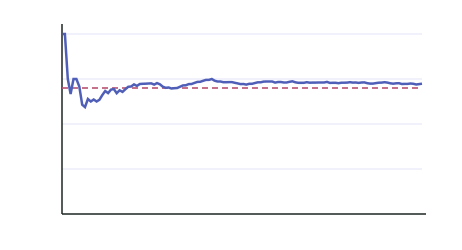
- Early on (few trials) the estimate swings widely; by several hundred trials it is close to and stable near the true value.
- This is why a good simulation uses many trials — the more you run, the more you can trust the estimate.
Comparing with theory
- If the true probability can be calculated, the simulation estimate should be close to it (closer with more trials).
- A large gap suggests too few trials, or a design error (a wrong assignment or trial definition) worth re-checking.
A student simulates a fair coin landing heads, using 10 trials, and gets 7 heads — an estimate of 0.7. They conclude the coin is biased. Is this reasonable?
Step 1 — Consider the number of trials
10 trials is very few. With so few, the estimate swings a lot — getting 7 heads out of 10 from a fair coin is entirely common.
Step 2 — What the long-run says
For a fair coin the true probability is 0.5. A running estimate would settle toward 0.5 only after many more trials; 0.7 from 10 trials is well within normal chance variation.
Step 3 — Conclusion
Test yourself
Practice by grade
One question each at Achieved, Merit and Excellence. Have a go, then compare with the model answer.
Why does a simulation with 500 trials usually give a better estimate than one with 10 trials?
Two students simulate the same event. One runs 20 trials and gets 0.15; the other runs 400 and gets 0.23. Whose estimate should you trust more, and why?
A student says 'to get a better estimate of the probability of at least 4 makes in 5 shots, I'll make each trial 20 shots instead of 5.' Explain why this does not help, and what they should do instead.