Parallel and perpendicular lines
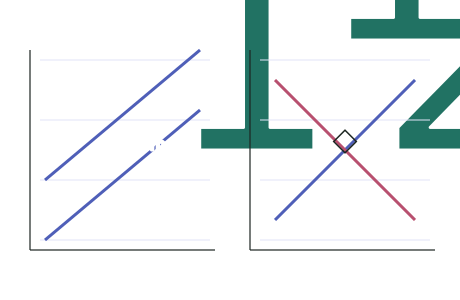
Parallel lines have equal gradients
- Parallel lines run in the same direction and never meet — so they have the same steepness.
- Two lines are parallel when their gradients are equal:
- To test if lines are parallel, put both in the form and compare the gradients. Different intercepts, same gradient ⇒ parallel.
Perpendicular lines have gradients that multiply to −1
- Perpendicular lines cross at a right angle ().
- Their gradients multiply to give :
- In words: the perpendicular gradient is the negative reciprocal — flip the fraction and change the sign.
- gradient perpendicular gradient
- gradient perpendicular gradient
Finding the equation of a parallel or perpendicular line
- Read the gradient of the given line (rearrange to first).
- Keep the gradient for a parallel line; take the negative reciprocal for a perpendicular line.
- Use the new gradient with the point you are given in .
Find the equation of the line perpendicular to that passes through .
Step 1 — Read the given gradient
The given line has gradient .
Step 2 — Take the negative reciprocal
Check: ✓.
Step 3 — Use the point in point–gradient form
The perpendicular line is .
Test yourself
Practice by grade
One question each at Achieved, Merit and Excellence. Have a go, then compare with the model answer.
Achieved
Write the gradient of a line parallel to , and the gradient of a line perpendicular to it.
Merit
Find the equation of the line parallel to that passes through .
Excellence
A line joins and . Find the equation of the line through that is perpendicular to , giving your answer in the form .