The gradient of a line
What gradient measures
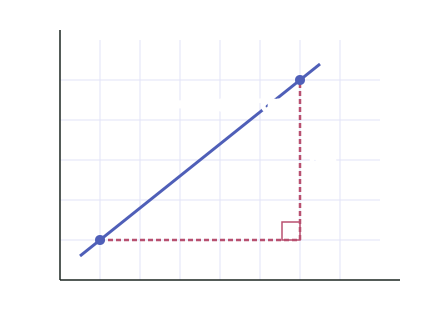
- The gradient of a line is its steepness — how much it rises or falls for each step across.
- It is the same all the way along a straight line: pick any two points on it and you get the same value.
- Gradient is written as .
The gradient formula
- rise () — the change in (up is positive, down is negative).
- run () — the change in (right is positive).
- Subtract the -values on top and the -values on the bottom, in the same order.
Reading the sign and size of a gradient
- Positive gradient — the line goes up from left to right (rise and run have the same sign).
- Negative gradient — the line goes down from left to right.
- Zero gradient — a horizontal line (); it never rises.
- Undefined gradient — a vertical line (); you would divide by zero, so it has no gradient.
- The bigger the size of , the steeper the line: a gradient of is steeper than a gradient of .
A wheelchair ramp rises in a straight line from to , where units are metres. Find its gradient.
Step 1 — Choose the order and find the rise
Take as point 1 and as point 2:
Step 2 — Find the run
Step 3 — Divide and simplify
The ramp rises m for every m across — a gradient of , which is gentle (well under the maximum many building codes allow).
Test yourself
Practice by grade
One question each at Achieved, Merit and Excellence. Have a go, then compare with the model answer.
Achieved
Find the gradient of the line through and .
Merit
A line passes through and . Find its gradient and state whether the line rises or falls from left to right.
Excellence
The points , and lie on a design. By comparing gradients, determine whether the three points are collinear (lie on one straight line).