The equation of a straight line
The gradient–intercept form
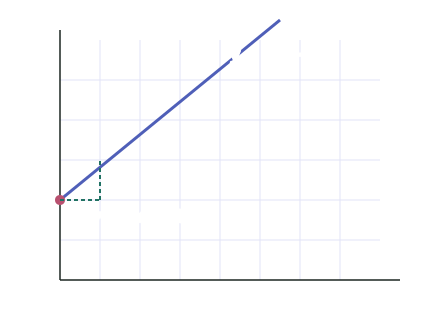
- Every straight line can be written in gradient–intercept form:
- — the gradient (steepness), the number multiplying .
- — the -intercept, the -value where the line crosses the -axis (where ).
- Read off both numbers directly: in the gradient is and the line crosses the -axis at .
Finding the equation from a gradient and a point
- You need two facts: the gradient , and one point the line passes through.
- The quickest route is the point–gradient form:
- Substitute , and , then rearrange into .
- If you are given two points instead, first find the gradient with , then use either point.
Rearranging into the general form
- NCEA answers are often wanted in the tidy general form , with whole-number coefficients and no fractions.
- Multiply through by any denominator, then move every term to one side.
Find the equation of the line through and , giving your answer in the form .
Step 1 — Find the gradient
Step 2 — Substitute a point into point–gradient form
Using :
Step 3 — Expand and rearrange
The line is . Check with : ✓.
A line has gradient and passes through . Write its equation in the form with integer coefficients.
Step 1 — Point–gradient form
Step 2 — Clear the fraction (multiply by 2)
Step 3 — Move everything to one side
Test yourself
Practice by grade
One question each at Achieved, Merit and Excellence. Have a go, then compare with the model answer.
Achieved
Write down the gradient and -intercept of the line , and find when .
Merit
Find the equation of the line through and , in the form .
Excellence
A phone plan charges a fixed monthly fee plus a rate per GB. For 2 GB the bill is $30; for 5 GB it is $45. Model the bill against data with a straight line, and use it to find the fixed fee and the cost of 8 GB.