Impacts, and evaluating them
What the standard asks for
- Explain the social, economic and/or environmental impacts of the event. The and/or means you may use two categories, but three is usually stronger and no harder.
- An impact is a change caused by the event, in the environment or in how people live, work or move.
- Every impact needs a group, a direction, a size and a duration. Who, better or worse, by how much, and for how long.
- Duration is the one students forget, and it does most of the work later: an impact lasting 12 days and an impact lasting 30 years are not comparable.
- Include the positives. An event with no benefits would not have been held, and a one-sided account reads as an argument.
Sorting the impacts
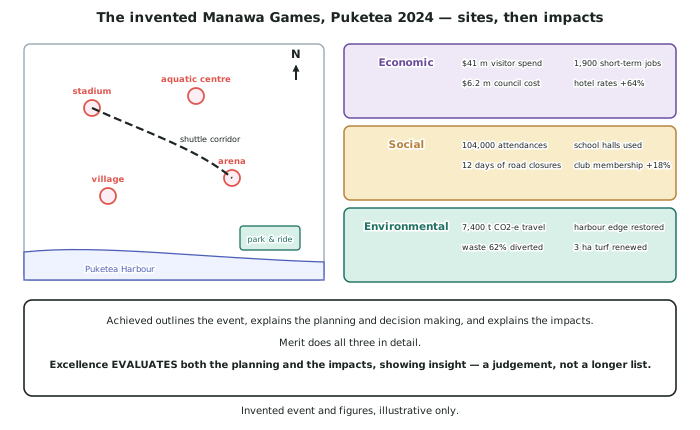
- Economic: spending, jobs, costs, prices, investment, and who paid. In the invented Manawa Games: $41 m visitor spend, 1,900 short-term jobs, $6.2 m council cost, hotel rates up 64 per cent.
- Social: attendance, participation, disruption, housing, community facilities. 104,000 attendances, 12 days of road closures, club membership up 18 per cent in the following season.
- Environmental: emissions, waste, water, land, habitat. 7,400 t CO2e of travel emissions, 62 per cent waste diversion, 600 m of harbour edge rebuilt, 3 ha of turf renewed.
- Attach a duration to each one. Road closures: 12 days. Turf renewal: about 8 years. Harbour edge: permanent.
- Say who each impact landed on. The $6.2 m council cost is paid by ratepayers; the 64 per cent rate rise was paid by visitors and captured by hotel owners.
Explaining an impact properly
- Give the mechanism, not just the number. Hotel rates rose 64 per cent is a measurement; demand from 3,100 competitors and their supporters met a fixed bed stock, so prices rose until demand matched supply is an explanation.
- Distinguish impacts caused by the event from changes that would have happened anyway. Club membership rising 18 per cent in one season is only an event impact if it did not rise in comparable years.
- Watch for displacement. Visitor spending of $41 m is not all new money — some of it is local spending diverted from other businesses, and some visitors displaced other visitors who stayed away.
- Follow one impact through several categories. The road closures were social (access), economic (retail trade inside the closure), and environmental (a temporary fall in city-centre traffic).
- The impacts worth most are the ones that changed something permanently, because they are still there when the event is gone.
Evaluating: the step that carries Excellence
- Achieved and Merit explain the impacts. Excellence evaluates them, and it must evaluate both the impacts and the planning.
- To evaluate you need a criterion, stated before you use it. Reasonable ones here:
- net benefit — did the gains exceed the costs, and for whom
- duration — did anything change permanently
- distribution — who received the benefits and who bore the costs
- counterfactual — what would have happened without the event
- Different criteria give different verdicts, and showing that is itself insight.
- Then commit. State which criterion you are using, why it suits this event, and what verdict it produces.
- A judgement with a number attached beats an adjective. The event returned about $2.30 of visitor spending for every $1 of council cost, though most of that return went to accommodation owners rather than to ratepayers is an evaluation.
Common traps in the impacts section
- Reporting the organisers' figures as findings. An economic impact report produced for an event is a claim, and often uses multipliers that assume no displacement. Say who produced each figure.
- Confusing gross with net. $41 m of visitor spend is a gross figure; the net gain to the city is smaller and much harder to measure.
- Ignoring the counterfactual. Some visitors would have come anyway; some residents left town for the duration; some spending was brought forward from later in the year.
- Treating short-term jobs as permanent ones. 1,900 short-term jobs over 12 days is a different thing from 1,900 jobs.
- Forgetting the legacy. The harbour edge, the renewed turf and the club membership are what remain, and they are usually the most defensible impacts to claim.
Worked Example
Worked example
Evaluate the economic impacts of a significant contemporary event you have studied.
Answer:
Step 1 — state the criterion first. I am evaluating on net benefit and distribution: did the city gain more than it spent, and who received the gain.
Step 2 — set out the claimed gain, and say who produced it.
The trust's own post-event report claims $41 m of visitor spending, against a council contribution of $6.2 m — a headline return of about $6.60 per dollar. That figure was produced by the organisation being evaluated, and it is a gross number.
Step 3 — adjust it, and show the working.
Three deductions have to be made before the number means anything:
- Displacement. Hotel occupancy reached 97 per cent, which means ordinary March visitors were crowded out. On a normal March occupancy of about 62 per cent, a substantial share of the beds sold would have been sold anyway.
- Leakage. Much of the spending was captured by accommodation and hospitality businesses, and part of that leaves the city as profit to national chains.
- Local substitution. Residents who attended the Games spent money they would largely have spent elsewhere in the city that month.
Taking these together, a defensible net new spending figure is perhaps half the headline — on the order of $20 m — and I would report it as an estimate with a stated range rather than as a fact.
Step 4 — apply the distribution half of the criterion.
The $6.2 m cost was borne by ratepayers. The gain was concentrated in accommodation and hospitality owners, who also captured the 64 per cent rate rise. The people who paid and the people who gained are largely different groups, and no mechanism transferred value between them.
Step 5 — reach the judgement, and note what would change it.
On net benefit the event was very probably positive for the city as a whole, even after deductions. On distribution it was regressive: a public cost produced a private gain, and the group that paid — ratepayers, including those disrupted by the road closures — received the least direct return.
The judgement would change if the council had captured part of the gain, through a bed levy or a share of concession revenue. That is a design choice about the planning, not a fact about events, which is why the evaluation of the impacts and the evaluation of the planning cannot be separated in this case.