Choosing the event, and outlining it
The four tests, in the order to apply them
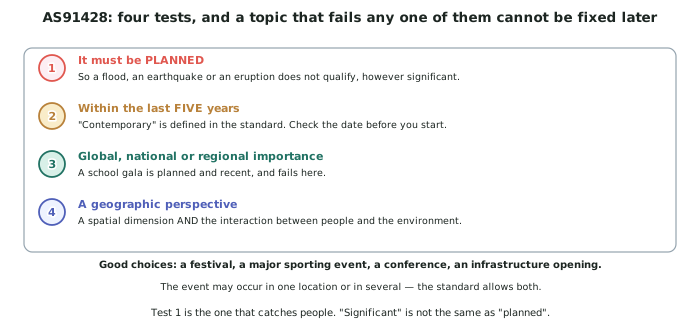
- Test 1: is it planned? Somebody had to decide it would happen, where and when. A natural disaster fails here — and this is by far the most common way a topic is lost.
- Test 2: is it within the last five years? The standard defines contemporary that way. An event from six years ago is not a borderline case; it does not qualify.
- Test 3: is it of global, national or regional importance? A school production is planned and recent and fails this. Ask whether anyone outside the district reported on it.
- Test 4: does it have a geographic perspective? It needs a spatial dimension — it happened somewhere, and where mattered — and an interaction between people and the environment.
- Apply all four before you collect any data. A topic that fails one of them cannot be rescued later by good research.
What "a geographic perspective" actually requires
- A spatial dimension means the event has a geography: sites, routes, catchments, zones of effect, places that were affected differently from other places.
- The interaction between people and the environment means the event changed the environment or the environment shaped the event — usually both.
- Test your event with one question: could I draw a map of this? If the honest answer is no, it has no spatial dimension and it is the wrong topic.
- Events with a strong geography include anything with venues, road closures, crowds, transport, construction, waste, water use, or a decision about where to put something.
- Events with weak geography include a policy announcement, an online-only event, or something that happened entirely in one building with no effect outside it.
Outlining the nature of the event
- Outline is the weakest verb in this standard, and the section should be short — one page, not five.
- Cover six things: what it was, where, when, who organised it, who attended or was affected, and how big it was.
- Quantify. In the invented worked example, the Manawa Games in Puketea in 2024 drew 104,000 attendances across four venues over 12 days, in a city of 118,000 people.
- Locate everything. Name the venues and where they are relative to each other and to the city — the spatial dimension starts here, not later.
- Do not tell the story. A day-by-day narrative of what happened is not analysis, and it eats the word count the evaluation needs.
Sourcing your event
- Choose an event you can get documents about. Council agendas and minutes, resource consent applications, event reports, transport plans, media coverage and official statistics are all usable.
- Primary contact is worth a lot. An interview with an organiser, a council officer, a resident or a business owner gives you the decision-making evidence this standard needs.
- Collect the numbers early: attendance, cost, funding sources, jobs, transport movements, waste, water, road closures, and any before-and-after measurements.
- Record where every figure came from. You will need to say how reliable it is when you evaluate.
- Be careful with promotional material. An event's own economic impact report is evidence of what the organisers claimed, which is not the same as evidence of what happened — and noticing that difference is worth marks.
Structuring the whole report
- Four sections, in this order: nature of the event; planning and decision making; impacts; evaluation.
- Keep the outline short and give the space to the last two.
- Include a map early — venues, the affected area, transport routes — because it makes the spatial dimension visible and everything after it easier to write.
- Signpost the grade criteria. Headings like Evaluating the planning make it obvious to your teacher which criterion you are addressing.
- Word length is not the marked variable. A report that outlines briefly and evaluates properly beats a longer one that describes throughout.
Worked Example
Worked example
Four students propose topics. Apply the four tests to each.
- A: the 2023 flooding of a regional city.
- B: the school's 2024 production of a musical.
- C: a national multi-sport games held across one city over 12 days in 2024.
- D: a government policy announcement on housing, made in 2024.
Answer:
Topic A — the flood.
Planned? No. It fails test 1 immediately, and no amount of research will fix it. It is significant, contemporary, spatial and full of people–environment interaction — and still ineligible. (A student could pivot to the planned recovery programme or the planned stopbank upgrade, which are events in their own right.)
Topic B — the school production.
Planned? Yes. Within five years? Yes. Of global, national or regional importance? No. It fails test 3. A geographic perspective is also very thin — one building, no spatial dimension worth mapping.
Topic D — the policy announcement.
Planned? Yes. Recent? Yes. Nationally important? Yes. Geographic perspective? Weak. An announcement happens in one room; its effects have a geography but the event itself does not, and the standard asks about the event. Risky — likely to fail test 4.
Topic C — the games.
- Planned: yes, over several years, with a bid, a budget and consents.
- Contemporary: 2024, within five years.
- Importance: national, with teams from every region.
- Geographic perspective: four venues across the city, a shuttle corridor between them, road closures, a park-and-ride site, waste and water demand, and a harbour-edge restoration attached to the works. It can be mapped, and people and the environment clearly interact.
Topic C passes all four. Here is the outline it produces:
The Manawa Games were a national multi-sport event held in Puketea (population 118,000) over 12 days in March 2024. They were organised by a trust jointly funded by the city council and the national sporting bodies, and involved about 3,100 competitors from every region, with 104,000 attendances across four venues: the stadium and athlete village in the west of the city, the aquatic centre to the north, and the arena on the eastern harbour edge, linked by a shuttle corridor and served by a temporary park-and-ride site.