Evaluating social and economic significance
The verb that defines this standard
- Level 2 (AS91246) asks you to fully explain the significance of the topic for people. Level 3 asks you to EVALUATE it, and narrows it to social and economic significance.
- Explaining significance = saying who is affected and how.
- Evaluating significance = weighing it — how significant, compared with what, judged by what criterion — and defending the judgement.
- You cannot evaluate without a criterion, so state one before you use it.
- Excellence requires that evaluation to show insight, which here means a judgement that could have come out differently and that the evidence had to decide.
Social significance
- Social significance is about how the topic affects how people live: health, education, work, time, security, migration, and who bears the effects within a household or community.
- Be specific about the mechanism. Unreliable water supply affects education because time spent collecting water is time not spent at school, and the burden falls unevenly within households.
- Look at distribution within countries, not just between them. National averages hide the rural–urban gap and the difference between formal and informal settlement.
- Watch for the compounding effects. A topic that affects health, schooling and income at once is more significant than one with a single larger effect, because the effects reinforce each other.
- Say who is most affected and why — usually the people with least ability to substitute.
Economic significance
- Economic significance is about production, cost, work and growth: agriculture, industry, energy, trade, prices, and what a shortage forecloses.
- Quantify in the units the topic uses. For water, agriculture accounts for the large majority of global freshwater withdrawal, so an agricultural constraint is an economic constraint.
- Include the cost of the substitute, not just the cost of the shortage. Desalination is expensive, and its cost is what the scarcity is worth avoiding.
- Distinguish a cost from a transfer. Rising food prices are a cost to consumers and income to producers; a genuine economic loss is output that does not happen at all.
- Look at what it prevents. A constraint that stops an industry existing is more significant economically than one that makes an existing industry more expensive.
Criteria for evaluating significance
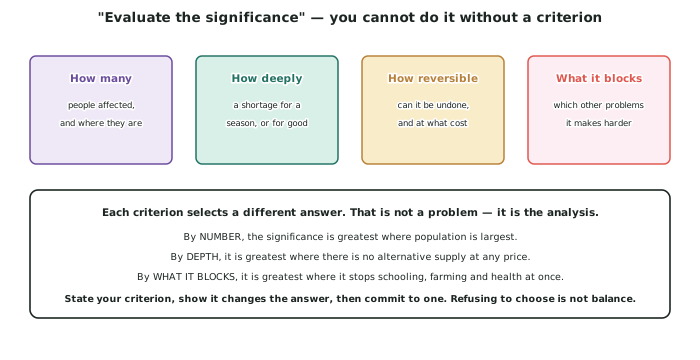
- Four defensible criteria, and they select different answers:
- How many people are affected
- How deeply — a seasonal inconvenience or a fundamental constraint
- How reversible — can it be undone, and at what cost
- What it blocks — which other problems it makes harder to solve
- Show that the criterion changes the answer, and then commit to one. That is the move the standard's evaluate is asking for.
- On number, significance is greatest where population is largest. On depth, greatest where no alternative supply exists at any price. On what it blocks, greatest where it constrains food, health and schooling simultaneously.
- Refusing to choose is not balance; it is an unfinished evaluation.
- Defend your criterion, not just your answer — the criterion is the part that can be argued with.
Common failures in this section
- Listing impacts instead of weighing them. A list is Achieved; the standard asks for a judgement at Excellence.
- Using a criterion without naming it. Most reports do use one implicitly, and naming it costs a sentence and gains a grade.
- Confusing scale with significance. A large number affected is significance on one criterion only.
- Ignoring who can substitute. Two populations facing the same shortage are not equally affected if one can buy its way out.
- Ending without a position. It is significant in many ways is where an unfinished evaluation stops.
Worked Example
Worked example
Evaluate the social and economic significance of water scarcity for people.
Answer:
Step 1 — state the criterion first, and defend it.
I am evaluating significance by what the shortage forecloses — which other things it makes impossible or much harder. I choose this criterion because water is an input to almost everything else people do, so its effects are compounding rather than additive, and a criterion based only on the number of people affected would miss what makes it different from other resource shortages.
Step 2 — show that a different criterion would give a different answer, which is honest and is the analysis.
On number affected, the significance is greatest in the densely populated basins of South Asia, where the largest number of people live under stress. On depth, it is greatest in the arid belts, where in some places no alternative supply exists at any affordable price. On my criterion the answer is different again, and I have to defend the criterion rather than assert the answer.
Step 3 — apply the criterion to social significance.
Where supply is unreliable, the effects run through several systems at once. Time spent obtaining water is time not spent in school or in paid work, and that burden falls unevenly within households. Health depends on both quantity and quality, so an unreliable supply raises disease burden, which in turn removes more time and income. Settlement becomes conditional: where supply fails seasonally, people move, and seasonal movement disrupts schooling and employment further.
None of these is the largest single effect of scarcity. Together they close off the two routes — education and stable work — by which a household would otherwise escape the conditions producing the problem.
Step 4 — apply the criterion to economic significance.
Agriculture accounts for the large majority of global freshwater withdrawal, so a water constraint is first an agricultural constraint, and therefore a constraint on the sector employing the largest share of the workforce in most affected regions. Its economic significance is not mainly the crop lost in a bad year — that is a cost. It is that certain activities never begin: an industry requiring reliable process water does not locate where supply is unreliable, and an irrigated cash crop is not planted where the season cannot be relied on. Foregone activity leaves no trace in any statistic, which is exactly why the criterion matters.
Step 5 — reach a judgement and support it with the anomaly.
On the criterion of what it forecloses, water scarcity is most significant where it is chronic and unsubstitutable — not where the raw numbers are largest. The evidence is the comparison the map itself provides: wealthy arid countries face the same physical shortage and it forecloses almost nothing, because energy and trade substitute for rainfall. The significance of the shortage is therefore determined less by its size than by whether it can be bought out of — which is a conclusion about inequality as much as about water.
Step 6 — state the limit.
This judgement depends on treating foregone activity as real, and foregone activity cannot be measured directly — I am inferring it from what does not exist, which is weaker evidence than a measurement. On a criterion restricted to measurable outcomes, my conclusion would be less strongly supported, and I would fall back to the number-affected criterion and a different answer.