The two constraints, and the six named features
Constraint one — original in construction
- The EN requires the text to be original in construction, then adds the clause most students never read: though components may be adapted or taken from other sources.
- Sourced components are allowed. A downloaded photograph, a stock illustration, a line quoted from a council submission — all permitted.
- What must be yours is the construction: the crop, the composition, the sequence, the placement, and the relationship between image and word.
- A sourced photograph cropped by you, with your line placed deliberately against it, is original in construction.
- A downloaded image with a caption typed underneath is not — nothing was constructed.
- This clause is good news. Because components are explicitly not assessed, all your effort can go into arrangement, which is the only thing being marked. Credit your sources anyway.
Constraint two — stand-alone
- The EN says the text must be stand-alone, and states outright that it is not part of an oral presentation.
- Everything a viewer needs must be inside the frame. The test: hand it to someone who has not spoken to you and say nothing. If they need you to explain the concept, it is not stand-alone.
- This is what disqualifies most slide decks, which carry fragments and rely on a speaker to supply the meaning.
- It also rules out the explanatory paragraph. Appending a block of body text fails twice: body text is read last or never, and clarity is supposed to live in the construction.
Choosing a form and a subject
- Static image or poster — one frame, so composition carries the whole load. Campaign of two or three images — lets you use sequence, and is the easiest place to demonstrate sustained. Picture book spread or comic — uses sequence, movement, costumes and dialogue, four of the six named features. Magazine feature spread — strong on quotations and hierarchy.
- Pick the form that suits the idea, not the software you know. A form chosen for convenience gives you nothing particular to arrange, and arrangement is what is assessed.
- A large subject cannot be composed. Climate change has no dominant image, because it has no single object. Narrow until one concrete thing carries it: not water quality but one cup of water from one named river.
- A named place beats a general one, and a checkable number beats an adjective. 3× the 1998 level survives scrutiny; dangerously high does not.
- Test before drafting: can you name the one image the viewer will see first? If not, the subject is still too wide.
The six features the standard names
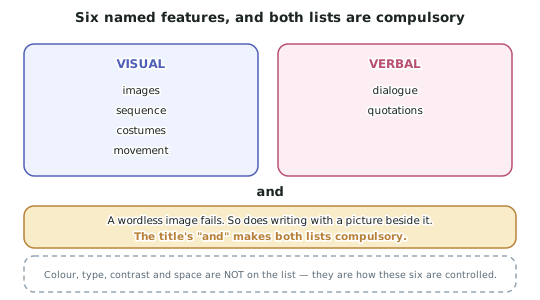
- Name these features in your own commentary. An internal is marked on evidence of deliberate choice, and the standard's own words make that deliberateness visible.
- Images. One dominant image beats three competing ones — two equal focal points cancel rather than double. Crop hard: cropping is free, it is the strongest single edit, and it is unmistakably a decision. What is left out is a choice — space around a subject reads as isolation, a crowded frame as pressure, and a subject cut by the frame edge as continuing beyond it.
- Sequence is the order panels are read and the order the eye travels within a frame. Across frames, what you place next to what creates meaning present in neither panel alone.
- A sequence must be irreversible. Swap panel two and panel three: if nothing is damaged, you have variations, not a sequence.
- The strongest device is a constant element in a changing context. Hold one thing identical — same crop, same position — and change everything around it.
- Costumes. What figures wear and what it signals. A uniform is the highest-yield costume available, and costume is never neutral. A change of costume across a sequence shows change without words — the same high-vis vest, dry in panel one and soaked in panel three, is a night passing.
- Movement. In a still image it is implied — a figure mid-stride, a gaze out of frame, or a diagonal composition, since diagonals read as active and horizontals as settled. Across a sequence it is actual.
- Dialogue is speech attached to a figure the viewer can locate. Unattached speech is not dialogue; a floating slogan is the poster talking to itself.
- Quotations. A quoted voice carries authority a slogan does not. Attribute with a role and a context — resident, submission to council, March is evidence; Sam is decoration. A real quotation beats an invented slogan, and the EN explicitly permits sourced components.
- Words are scarce, so each is load-bearing. A specific noun outperforms an urgent verb: Rangiuru Rd, 6.40 a.m. can be pictured; SAVE OUR RIVER fits any river anywhere.
Composition — where control is demonstrated
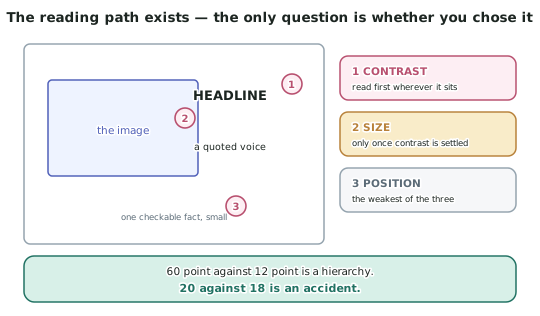
- Hierarchy is the deliberate ranking of elements. Decide the first, second and third thing read, and nothing else. Four near-equal elements is the commonest failure of all.
- Space is the strongest emphasis available, and the one students never use, because empty space feels unfinished. An element with room around it is the only one asking for anything.
- Shrink the draft to thumbnail size. Detail disappears and only hierarchy remains. If you cannot tell what is first, no dominant element exists.
Worked Example
Worked Example
A student plans a three-panel campaign, "The Last Bus", about a rural route being cut. The first plan is described specially for this page.
Diagnose it against the named features and rebuild it.
The faults. Every panel changes subject, distance and angle at once, so the viewer has nothing to measure the change against — and panels 1 and 3 could swap with no loss: three images, not a sequence. Two panels are wide, so the eye lands nowhere. Costumes are unused, discarding a named feature when a figure is present twice.
The rebuilt plan.
Why it works. The identical crop creates the constant, so the viewer reads the difference rather than three pictures. The high-vis over a school jersey says student and worker in one glance, and that double shift is the campaign's argument. The wet vest shows a night passing without stating it. The empty pole is the strongest final beat, because the viewer supplies the reason.
Testing it. Swap panels 2 and 3: the empty pole now precedes the wet figure and the text collapses. The original plan survived the same swap unchanged.