How image and word relate
The skill the standard is actually assessing
- The Explanatory Notes allow components to be adapted or taken from other sources, so neither the photograph nor the sourced quotation is assessed. What is marked is how the components have been put together — and the largest such decision is the relationship between image and words.
- The title's word and makes this unavoidable. This is where most texts are lost, and the loss is invisible to the student, because both halves look fine on their own.
The three possible relationships
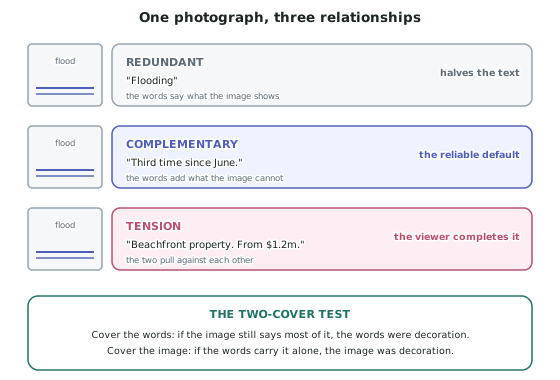
- Redundancy halves the text. Both channels deliver the same content, so the text says one thing where it could have said two, and no quality in either element recovers the loss.
- Complementary is the reliable working default, and it is reached by asking what the image cannot say — a number, a name, a date, a cause, a voice.
- Tension is the strongest, because the viewer completes the meaning themselves.
Why tension works
- Nothing is claimed. In Beachfront property. Prices from $1.2m. over a flooded street, no sentence asserts anything about risk or denial. The argument exists only in the collision.
- A claim can be refused; a collision cannot. A viewer can disagree with an assertion. They cannot disagree with two facts placed next to each other, because neither is arguing.
- It is free. Tension needs better arrangement, not better materials — which matters in a standard that declines to assess materials.
How to build the relationship deliberately
- Decide which of the three you want before drafting. Redundancy is never chosen; it is what happens when nothing is chosen.
- Build the image first, then write against it. A picture found to match a slogan was selected for agreeing, so it can only repeat.
- For tension, find a sentence someone would actually say. An attributed quotation contradicting the image is stronger than an invented one, because the text did not write both halves.
- Set the order of reading. Tension fires only if the viewer meets the image first and the contradicting words second. Reversed, the image becomes a punchline, which is a weaker effect.
- Test by removal — the two-cover test. Both halves should be diminished by the loss of the other. That is the operational definition of a visual and verbal text.
Where the relationship usually breaks
- The headline names the subject. SAVE OUR RIVER over a river — the commonest fault in the standard, and it happens because a headline feels like a label.
- The caption describes the photograph, or the words explain what to conclude — which removes the conclusion from the viewer.
- Both channels shout. A dramatic image with an urgent slogan is two channels at maximum, which reads as noise and leaves no contrast for anything to stand out against.
In a sequence, the relationship can change
- A multi-panel text can move between the three relationships, and that movement is itself a structure. A common shape: complementary, complementary, tension.
- Holding the words constant while the image changes is the sequence version of tension: the same line means something different under each picture, and by the third the viewer has noticed the line has not changed.
Worked Example
Worked Example
A student is making a single-image poster on water quality in a local river. Both drafts are described specially for this page.
Draft one.
Rework it.
What fails. The eye has nowhere to land: river, banks, trees and hill all compete. The words are redundant — SAVE OUR RIVER over a photograph of a river — and that redundancy occupies the most-read position while the complementary detail sits in 12-point at the bottom, which is the worst possible allocation. The slogan fits any river anywhere, the clip art is the one element not original in construction, and the horizontal composition reads as settled, contradicting the urgency intended.
Draft two.
What each change does.
| Change | Feature | Why it works |
|---|---|---|
| Tight crop to one hand and one cup | Images | The whole river is an abstraction; a cup of it is evidence the eye can resolve in two seconds |
| Diagonal composition | Movement | Diagonals read as active; the horizontal draft contradicted its own message |
| Slogan replaced by an attributed quotation | Quotations | A named voice carries authority, and stops the poster speaking in the voice of nobody |
| The quotation contradicts the image | Tension | "It's fine" against visibly brown water. The poster never argues; the viewer resolves the gap |
| One checkable fact at the bottom | Body text | 3× the 1998 level at a named site is checkable; levels have risen is not |
Run the two-cover test on draft two. Cover the words: an ambiguous photograph of cloudy water. Cover the image: a reassurance and a nitrate figure. Each half is genuinely diminished by the loss of the other, which is what the title's word and asks for.