Structure, evidence and perceptive analysis
Why structure is content here
- The Explanatory Notes require the discussion to be communicated clearly, in a structured written answer that follows the conventions of an essay format.
- That makes essay structure examinable, not presentation advice. An answer in bullet points or notes has not met the standard however good the analysis is.
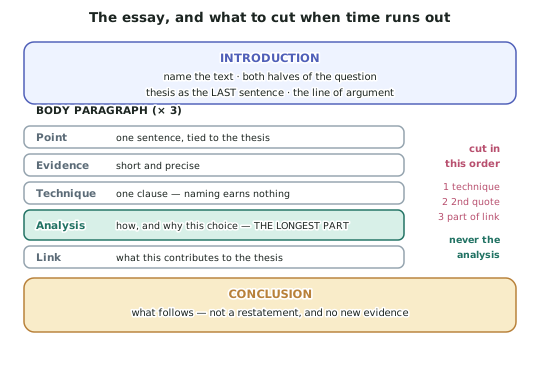
- Keep the introduction to five or six sentences, and never open with a general statement about literature. Throughout history, writers have used setting to… costs a sentence and says nothing.
- Quote short, analyse long. An essay of long quotations with short comments looks like padding because it is.
- The conclusion says what follows — what a reader now understands that they did not at the start, in the thesis's own claim but sharper wording. If your thesis was qualified, the limit is resolved here rather than introduced. Three or four sentences is enough.
Choosing evidence, including evidence you cannot quote
- Good quotations are short, rich (a metaphor, a striking word, odd syntax) and flexible (usable for more than one question).
- Prepare eight to ten short quotations across the four categories, and group them by what they could argue, not by where they appear. A quotation filed under chapter four is unfindable in an exam; one filed under the cost of loyalty is not.
- Not all evidence is quotation, and the non-quotable kinds are often the strongest:
- Structural placement — that a scene comes immediately after another, at the midpoint, or last.
- Absence — that a character is never described, named or heard. Absence needs a count or a span: never once in six chapters.
- Repetition and pattern — that an image recurs, roughly how often and where.
- Convention — that the form normally does something here and this text does not.
- These cost no memorisation, which makes them the most reliable material in a timed exam — and they survive the question you did not predict.
- Be precise anyway. Near the end is weak; in the final two pages, after the funeral is checkable.
Correct is not the same as insightful
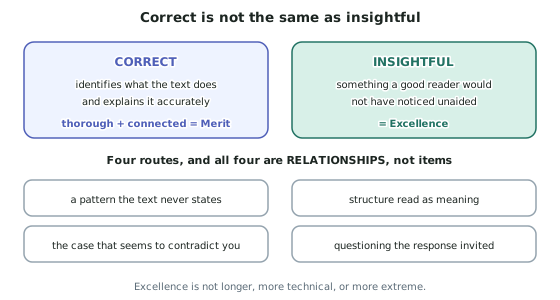
- The reader of your essay should learn something. That test is higher than being right.
- The and/or matters. You may be insightful about something obvious, or original about something small.
- Excellence is not more of anything: not longer, not more technical (anaphora for repetition changes no interpretation), not more quotations, not more extreme (original means original and defensible), and not more feeling — personal response is assessed by AS91106, not here.
- Substitutes markers recognise instantly: elevated vocabulary in place of a sharper claim; terminology used as a label; an asserted intention with nothing behind it; length offered as thoroughness. All of them can be produced without re-reading the text. Genuine insight cannot, and that is the test.
- Insight must stay evidenced — the standard says supported by evidence in its title. If you cannot point to the words that made you notice it, the reading may be yours rather than the text's.
Worked Example
Worked Example
Use the "Shingle Road" extract from the previous page — the house whose windows all "faced inland", built "the year after the wave", with the sea heard "under the floorboards".
The question: Analyse how the writer used setting to develop an idea.
Show the same material written at each of the three levels.
Achieved — correct interpretation, in essay format.
The writer uses the setting of the house to develop the idea that the family are avoiding the past. Every window "faced inland", so the sea cannot be seen from inside. This shows the family have arranged their home to keep the memory of the wave out of sight.
Accurate, evidenced, and it explains how meaning is created. It is also everything the passage says on its surface.
Merit — reasoned interpretations, connected. One paragraph, labelled:
The arrangement of the house is a decision the living generation did not make. [Point] Every window "faced inland", built in "1953, the year after the wave", and "no one had ever changed it". [Evidence] The orientation is inherited architecture rather than personal choice. [Technique] Because the choice is dated and never revised, the family are not avoiding the sea; they are living inside somebody else's avoidance — and an inherited arrangement cannot be defended by the people obeying it. [Analysis — longest part] The setting therefore develops the idea that avoidance outlives the reason for it. [Link]
Excellence — insightful, without extra length. Two moves, both relationships:
- The three places the sea is heard are a progression, not a list. "Under the floorboards, behind the conversation, in the pause after someone asked a question" moves steadily inward: building, then speech, then silence. Its endpoint is where an unspoken thing actually lives, so the sentence does not describe avoidance — it locates it.
- The dates are the argument. "1953" and "seventy years" pass without comment, and their function is arithmetical: the pretence has outlasted everyone who had a reason for it. The text never says the avoidance has become meaningless; the numbers say it.