The thesis, and connecting your interpretations
What a thesis is
- A thesis is your answer to the question, stated in one sentence, that the whole essay then supports. It is what delivers the connection Merit requires.
- A thesis is not a plan. I will discuss three techniques announces an itinerary. A thesis is not a summary either — retelling what happens says nothing about how the text works.
- It must do three things:
- Answer the question directly, in the question's own terms.
- Be arguable — a well-informed reader who had read the same text could disagree without being obviously wrong.
- Be specific enough to guide the essay — reading it tells you what each paragraph must show.
Four attempts, compared
| Attempt | Verdict |
|---|---|
| This essay will discuss the setting in the text I studied. | Announces a topic, argues nothing |
| The setting is important in the text. | True of every text ever written |
| The setting shows that the family are avoiding the past. | Arguable, but every paragraph would say it again |
| The writer uses the setting less as a backdrop than as an opposing force, so that the family's defeat feels decided by their surroundings rather than their choices. | A thesis — answers, argues, and tells you what each paragraph must show |
Building one
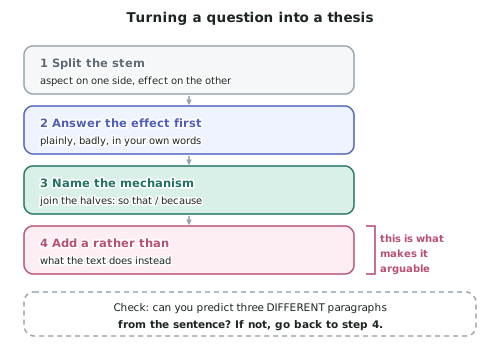
- Test it four ways before committing.
- Disagreement — could a well-informed reader disagree? If not, you have described.
- Prediction — if you predict the same paragraph three times, the thesis has no internal structure.
- Before-reading — could this sentence have been written by someone who had not read your text? If yes, it is a general truth about literature.
- Verb — a thesis whose main verb is is or shows is usually a description. Withholds, converts, refuses, postpones force a claim.
- It goes as the last sentence of the introduction, and it does not change mid-essay. If paragraph three has drifted, fix paragraph three.
- A thesis may be qualified. Mostly, until the final chapter, for the adults but not the child are all legitimate. A limited claim you can prove beats a sweeping one you cannot.
The Merit wording, exactly
- Merit is convincing analysis: reasoned and clear interpretations, plus a requirement that is unusual — the majority of these interpretations are connected to each other.
- It is a requirement about the relationship between your points, not about the points themselves. An essay can contain three accurate, well-evidenced interpretations and miss Merit because nothing was said about how they relate.
- Majority matters: one paragraph standing slightly apart will not sink the essay. Two out of three will.
The reorder test
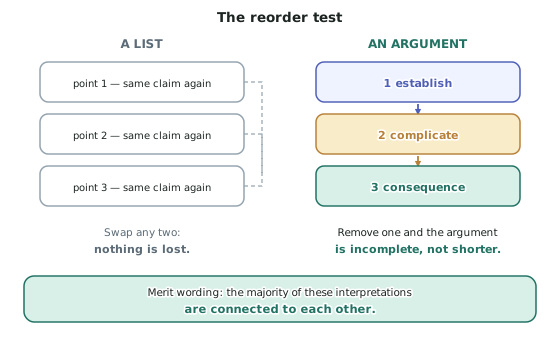
- Apply it while planning. Reordering a plan takes seconds; reordering an essay takes the exam.
- A stronger version: could paragraph three be understood by someone who had not read paragraph two? If it could, paragraph two is doing nothing for it.
Three ways paragraphs can build
- Development — the second takes the first further along the same line. The house is arranged to exclude the sea. That arrangement also governs how the family talk.
- Complication — the second shows the first is not the whole story. The arrangement works visually. It fails acoustically, and the failure is the point.
- Consequence — the second draws out what follows. Because the decision was made before the living generation, nobody is choosing avoidance; they are inheriting it.
- Complication is the most valuable and least used. Students avoid it because it feels like arguing against themselves. It is the opposite: an argument that has survived an objection is more convincing than one that never met any.
- If your thesis is qualified, the paragraph establishing the limit goes second to last — placed last it is the reader's final impression and undercuts the essay.
Making the connection visible
- End each paragraph on the thesis, not on the technique. The last sentence says what this point contributes.
- Use logical connectives, not additive ones. Therefore, but, which is why, this only holds until carry argument. Also, another, furthermore, similarly carry lists.
- Do not fake it. A connective bolted onto two unrelated paragraphs is worse than an honest list, because it advertises that connection was known to be required.
Worked Example
Worked Example
The extract below was written for this page and can be quoted freely.
The question: Analyse how the writer used setting to develop an idea.
Take the same three observations and arrange them first as a list, then as an argument.
Version A — three interpretations, listed.
- Paragraph 1. The windows "faced inland", which shows the family are turning away from the sea.
- Paragraph 2. The sea is "under the floorboards", which shows it is still present.
- Paragraph 3. Ruth listens at night, which shows she is aware of the past.
Each paragraph is accurate, and each ends by restating the same idea in different words. Swap any two and nothing is lost — so this is a list, and Merit is not met however well each paragraph is written.
Version B — the same three observations, connected.
- Paragraph 1 — establish. The orientation is a dated decision: every window "faced inland", built "the year after the wave", and "no one had ever changed it". Because it was never revised it now belongs to people who did not make it.
- Paragraph 2 — complicate. The arrangement does not work. The ordinary catalogue — "the hills, the shelter belt, the long brown paddocks" — is undercut at once: "You could not see the sea at all. But you could hear it." Sight can be designed away; sound cannot. So paragraph 1's inheritance is an inheritance of a failed solution.
- Paragraph 3 — consequence. Because the sea cannot be excluded, it migrates: "under the floorboards, behind the conversation, in the pause after someone asked a question". The setting develops the idea that avoidance reorganises a family's life without removing what is avoided.
Apply the reorder test. Paragraph 2 depends on 1, because failed requires the arrangement to have been established; paragraph 3 depends on 2, because the sea only migrates if it could not be excluded. The order cannot be shuffled.