The exam paper and the four aspects
What the paper gives you
- Five questions. You answer ONE. There is no compulsory question and no second essay.
- Every question begins with the same two words: Analyse how… The verb never changes. What changes is the aspect named and the effect it is tied to.
- You write in a booklet provided, with a tick box for the text type and space for the title and author.
- Written texts and visual or oral texts are separate booklets, and you may not answer both. AS91098 is the written booklet.
- The paper carries its own guidance: a concise essay of no more than four to five pages, and the quality of your analysis matters more than the length.
The glosses printed on the paper
- The paper defines its own key words in small print beside the questions, and they are wider than students expect.
- Setting may refer to physical places as well as social and historical contexts.
- Ideas may refer to character, theme or setting, so an ideas question can be answered through a character.
- Structure may refer to the order, organisation or conventions of a text.
- The glosses widen your options, not narrow them. A student who reads setting as scenery, and whose text is set in an ordinary suburb, will think the question is unanswerable when it is not.
Reading a stem
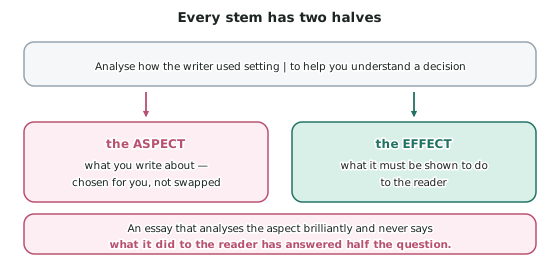
- Underline both halves, then write both into your thesis.
- Specified in the standard's title means the aspect is chosen for you. You may not swap it for one you prepared.
The grade ladder
| Grade | The standard's word | What it means |
|---|---|---|
| Achieved | analyse | You explore and interpret how meanings and effects are created, in essay format |
| Merit | convincingly | Reasoned and clear interpretations, and the majority are connected to each other |
| Excellence | perceptively | Insightful and/or original interpretations |
- These three words are used across the rest of this topic without being redefined.
The four aspect categories
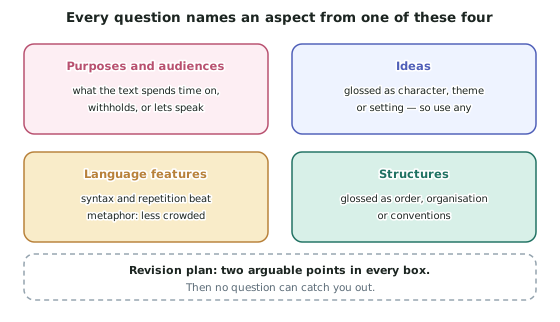
- The categories overlap, and that is allowed. A symbol is a language feature; what it symbolises is an idea; where it appears is structure. Keep the named aspect in charge of every paragraph, and cross into the others only as support.
- An idea is not a topic. Family is a topic. That loyalty to a family can require dishonesty toward it is an idea, because it can be disputed. Turn every topic into a proposition, or the essay will describe rather than analyse.
- Structural claims are often the most original, and frequently need no quotation at all. Have ready: where the text begins; where it ends, and whether the ending returns to the opening; the order of events against the order they happened; what is withheld, and for how long.
Choosing your question, and the prepared-essay trap
- Choose on evidence, not on interest. Three checks: can I state a thesis in one sentence?, can I name three points that differ from each other?, do I have short quotations for each?
- Spend two minutes deciding, then commit. Switching ten minutes in costs more than a slightly worse choice.
- The commonest failure in this standard is the prepared essay — the essay a student revised, with the question appearing only in the first and last sentences. It can be detailed, accurate and well written and still be capped at Achieved, for two separate reasons.
- It analyses unspecified aspects. The standard credits analysis of the aspect the paper named.
- It does not connect. Memorised paragraphs sit side by side, which is exactly what the Merit wording excludes.
- Prepare material and arguments, not essays.
Worked Example
Worked Example
The extract below was written for this page, so it can be quoted freely.
Show how the same extract answers a question from each of the four categories.
Answer: the material does not change. What changes is what the paragraph is in charge of.
Purposes and audiences — Analyse how the writer positioned you to judge a change.
The text never says the new ferry is worse. It arranges the judgement: the old routine is given in habit and duration — "eleven years", "every morning" — the new one in a comparison ending in nothing, "like a bus, like a plane, like anywhere".
Ideas — Analyse how an idea was developed through a character.
The idea is that attention is a choice most people have stopped making. Whetū does not protest; she stands. The count — "the only one", then "four of them" — makes a private preference spread.
Language features — Analyse how language features were used to sway your emotions.
The triple "like a bus, like a plane, like anywhere" degrades as it goes, ending on a word that names no place, so the sentence performs the loss it describes. The final clause gives its last position to "without turning" — a phrase about the port, and about the passengers.
Structures — Analyse how the ending of a text developed an idea.
The extract ends on the people who are not its subject: the final clause pulls back to the "rows of headrests". The structure withholds any statement of meaning and stops at the image.