Building the essay, and what perceptive looks like
Why this standard needs a thesis
- The Explanatory Notes require the conventions of an essay format, and an essay's defining convention is that it argues one thing. Structure is therefore examinable content — and the cheapest preparation in the standard, because it does not depend on which question comes up.
- A thesis is a claim about the text that answers the question asked — not a topic, a summary, or a promise to discuss three techniques. It must be contestable, supportable from three moments, and on the question, using the aspect and audience verb the stem named.
- The verb test. If the main verb is uses, shows or is about, it is not yet an argument.
- From stem to thesis: underline the aspect and the audience verb; list three describable moments; ask what all three are doing; state that as a claim about the audience; add a limit — in the second half, until the final sequence.
Connection — what Merit actually requires
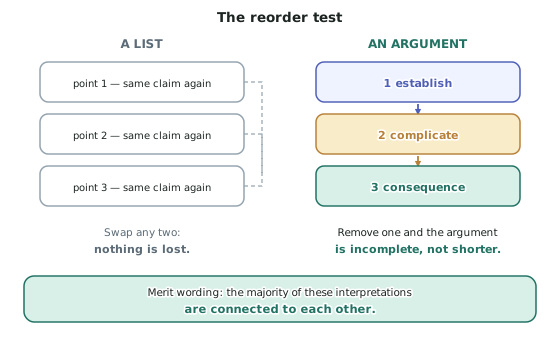
- The wording is each other, not the question: three points can all serve one thesis while remaining independent, like three witnesses who never met.
- Two tests. The reorder test — could paragraphs two and three be swapped with no loss? The deletion test — could paragraph two be deleted and three still make sense?
- Three ways one paragraph can depend on another.
- Development — the second does the same thing at a larger scale: a choice inside one scene becomes a pattern across the text.
- Complication — the second finds a case that qualifies the first. This holds everywhere except…
- Consequence — the second shows what the first made possible: because the audience has been placed outside the family, the ending's small gesture lands as inclusion.
- Organise by argument, not by feature. One paragraph per technique produces interchangeable paragraphs by construction. A paragraph may use three features at once if all three do the same work at that stage.
- Watch your connectives. Also and another announce a list; because and so announce dependence.
The shape of the essay
- Introduction — four sentences. Name the text, its creator and its type; state the thesis; signal the shape of the argument; and answer the question here, not in the conclusion.
- Body paragraph — five parts: claim (this stage of the argument, in the language of the question), evidence (the described shot, cut, sound or delivery), analysis (what the choice does and how — the longest part), effect on the audience (the paper's verb), and link back to the thesis and forward.
- If you run out of time, cut in this order: the link, then the second piece of evidence, then the stage-signalling. Never cut the analysis.
- The hour: ten minutes planning, forty writing, ten checking — and in checking read only the first and last sentences of each paragraph, which should form the argument alone.
Evidence when there is nothing to quote
- Five reliable kinds: a described shot precise enough to picture; a count or duration, the closest a visual text gets to a quotation; a line of dialogue, kept short; a placement; and an absence, but only anchored with a boundary and a named expectation.
- The plot is not evidence. Then she tells him she is leaving and he doesn't respond is a summary; the announcement is placed on the return to the opening framing is analysis of a choice.
- The verb test for recount: if most main verbs belong to characters — she says, he turns — it is recount. In analysis they belong to the text or the audience.
What perceptive looks like here
- Excellence is perceptively — insightful and/or original interpretations. It is not more. A longer essay with more techniques and more terminology describes a thorough essay, and thorough is Merit.
- The obstacle is specific to this standard: visual and oral techniques are conventionalised. Low angle means power, minor key means sadness, fast cutting means tension. Those meanings are shared, and the director relied on you decoding them — so decoding a convention is correct and redundant at the same time. It is why technique-by-technique essays plateau at Merit however accurate they are.
- The way past it is relationships, because individual features belong to a shared language and the relationships between them are the director's own.
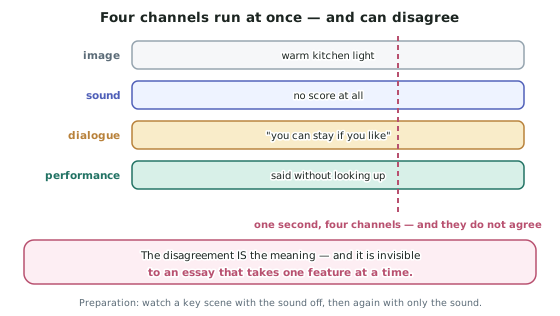
- Patterns across the text. A single low angle is a shot; the same framing recurring at three points is a structure. Ask what recurs — and, more revealingly, what has changed each time it returns.
- The break in the pattern. Once a text has a habit, the moment it stops is the most loaded in the text. Most candidates analyse the habit; the exception is where the meaning sits.
- Absence. No score. No reverse shot. No close-up at the emotional climax.
- The convention used against itself — a low angle on someone powerless, a swelling score over an anticlimax. Reading that is not decoding; it is noticing that the code was being played with.
- Four substitutes markers recognise instantly: more techniques (eight-technique essays are usually shallower than three-technique ones); more terminology (chiaroscuro for strong contrast changes no interpretation); retelling with technical words attached; and strained originality — a reading the text will not support is worse than an obvious one it will.
- The limit. The title says supported by evidence, so a perceptive claim you cannot anchor is assertion. The strongest position is an unobvious claim carried by a duration, a count and a placement the marker can check.
Worked Example
Worked Example
Text: "The Kitchen" from the first page — six shots, no score, the peeling stopping at the announcement, the father shown from behind and then by his hands, and Shots 1, 4 and 6 in identical wide static framing.
Stem: Analyse how sound was used to manipulate the viewer's response to a character.
Step 1 — three describable moments, and what they share. No score at any point in the scene's forty seconds; the only continuous sound is the peeler; the peeling stops at the announcement and resumes under his reply. All three are decisions about what the audience is allowed to hear instead of a reaction.
Step 2 — the thesis.
Step 3 — three paragraphs that depend on each other.
| Paragraph | Claim | Dependence |
|---|---|---|
| 1 | The absent score removes the usual instruction about how to feel, so attention transfers to the peeler. | the condition |
| 2 | Because the peeler is all there is, its stopping becomes the loudest event, and we read a reaction we were never shown. | consequence of 1 |
| 3 | When the peeling resumes under "There's kai in the oven", the sound that carried the reaction also closes it. | development of 2 |
Reorder test: 2 before 1 is incoherent. Deletion test: delete 2 and 3 has nothing to develop. Both pass.
Step 4 — and where Excellence would go. The Merit version above reports what the scene does. Three perceptive moves on the same evidence:
- The repeated framing is an argument, not a habit. Shots 1, 4 and 6 are the same wide static shot and nothing has changed between the first and the last, so the scene is built as a circle: the most significant announcement of Mere's life leaves the picture exactly as it found it.
- The one break in the pattern is the emotional centre. The father is denied a face throughout — but Shot 5 gives us his hands, motionless on the potato. The only access we are granted to his reaction is displaced onto an object.
- The plainest line, re-read. "There's kai in the oven" is the scene's most loaded line because it is the least responsive. Offered where an answer belongs, it does the work of one — care in the only register available to him.