The image and the cut
Why the techniques are your evidence
- A visual or oral text has no words on a page to quote. Its meaning is carried by decisions someone made, so your evidence is a described technique: the camera stays at knee height for the whole scene does the job a quotation does in AS91098.
- Naming a technique is not analysis. Use four steps, every time.
- Name the technique. One clause.
- Describe what the audience sees, precisely enough for a marker who has not seen the text to picture it.
- Explain the effect and how the technique produces it — not this shows he is powerful, but because we look up at him from below, we occupy the position of someone smaller in the room.
- Link it to the argument the essay is making.
- Never write "this shows" straight after naming a technique. Skipping the middle step is what separates a described essay from an analytical one.
Cinematography — the camera and the light
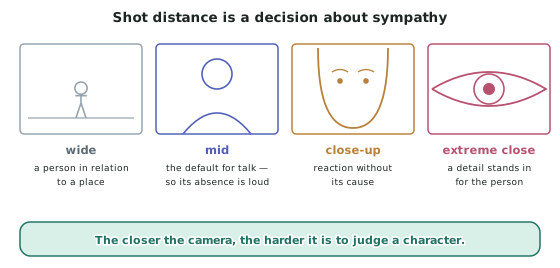
- Angle. Low angle gives dominance or threat, and puts the viewer in the position of someone smaller. High angle diminishes. Eye level means nothing, which is what makes a departure from it visible.
- Movement. A pan or tilt reveals something a character has not yet seen, so the audience knows first; tracking with a character ties us to them; handheld gives instability; a static camera in a scene of chaos is itself a choice.
- Focus. Shallow focus isolates one plane and decides what you may attend to. Deep focus keeps everything sharp, so background action can comment on foreground action.
- Lighting. High key is bright and even: open, safe, exposed. Low key is deep shadow: concealment, threat, ambiguity. Backlighting removes a face without a single cut.
- Framing is what is placed where and what is left out. A figure framed by a doorway is contained by it, and off-screen space is a tool — a voice or a reaction we are not shown makes the audience supply what is missing.
Production design
- Production design is everything placed in front of the camera: setting, set dressing, props, costume, hair and make-up, colour. Cinematography decides how it is photographed.
- Setting — a room's condition is characterisation without dialogue. Costume signals status and self-image, and changes in it track changes in character. Colour — a limited palette is always a decision.
- Props — an object that recurs becomes a motif. Tracking one object across a text is the most reliable source of original points here.
Editing — the cut as a claim
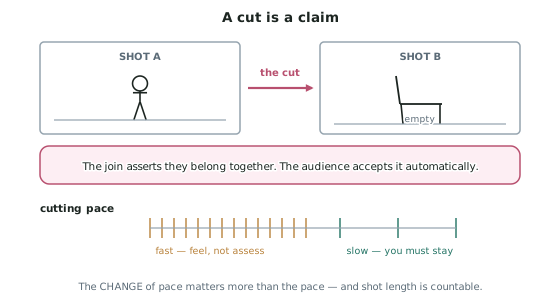
- Editing is the one feature the audience is designed not to notice, which is why analysing it well is unusually convincing.
- Your evidence is not a shot but a join: what was on screen, what replaced it, and when.
- Where the cutting speeds up tells you what the text thinks is urgent; where it slows tells you what it thinks matters.
- Cross-cutting alternates between two scenes and asserts a relationship — simultaneity, comparison or cause — that the text never has to state. A jump cut breaks a continuous action so you notice the cut itself.
- Eyeline match and reverse shot are the grammar of conversation, and their absence is loud: a character never given a reverse shot has been denied a point of view.
Worked Example
Worked Example
The text below was written for this site. It is one held shot — no cutting, no camera movement.
"The Yard", opening shot of a fictional NZ television drama. A static wide shot held twenty seconds of a suburban back yard at dusk. The camera is at waist height inside the kitchen, looking out through an open ranch slider, so the doorframe runs down the left of the image. Deep focus: a bench with two mugs in the foreground, a Hills hoist with one child's school uniform in the middle distance, a man in overalls at the back fence with his back turned. The yard is going blue; the only warm light is a bulb behind the camera, which reaches the bench and stops there.
Analyse how cinematography and production design positioned the audience in relation to a character.
Step 1 — what is doing the work? The camera's position inside the house, the deep focus, and the single warm light.
The camera never crosses the threshold, so we look out at the man rather than stand with him, and the audience is placed in the house he is not in. The deep focus keeps the mugs, the uniform and the man all sharp at once, so he is one item in a domestic inventory rather than the subject of the shot. The lighting completes the exclusion: the warm bulb falls on the bench and stops, so the warmth of the house ends exactly where he begins.
Step 2 — the effect, stated for the audience.
A weaker version — the director uses a wide shot with deep focus, which shows the man is isolated — names and asserts without saying what is in the frame, so isolated has nothing under it.