Sound, performance and oral texts
Sound
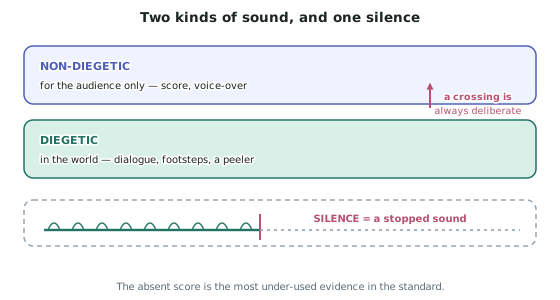
- Sound is the most under-analysed feature in this standard, which makes it a reliable source of original points.
- A crossing between the two layers is always deliberate — music that seemed to be a score and turns out to be a car stereo has moved you from outside the scene to inside it.
- Score tells you how to feel, often before the image does. Ask what the music is doing that the picture is not.
- Silence is the absence of an expected sound, not of all sound. After noise, silence is louder than noise, and a stopped sound marks a moment more sharply than any sound that starts.
- The absent score strips the scene of the ordinary instruction to feel, so the audience must interpret unaided.
- Sound and editing work in time rather than in the frame, so together they control what the audience knows and when — and they routinely disagree, which is where the meaning is.
Performance
- Performance is the feature most often left out of essays, because it feels like the person rather than a technique. It is a set of choices, describable as precisely as a shot.
- Delivery — pace, volume, pitch, emphasis, pauses. The pause before an answer is often the whole point, and which word is stressed changes the meaning of a line without changing a syllable of it.
- Gesture, posture and stillness — an actor who does not move in a scene of movement directs your eye more effectively than any camera choice. Restraint reads as stronger than shouting, because the audience supplies the feeling and therefore owns it.
- Do not evaluate the actor. A brilliant performance is a review. Describe the choice, not the quality: he delivers the line while still peeling, without raising his voice or turning around is evidence; he acts distant is an impression.
- Compare a line to its obvious alternative — how it would ordinarily be delivered, then what happened instead.
Rhetorical devices
- Rhetorical devices are the persuasive techniques of spoken and scripted argument — central to oral texts, speeches, documentaries and advertising.
- Rhetorical question — asks without wanting an answer, so the listener answers privately and hears their own agreement. Repetition and anaphora make a claim feel established rather than argued. Rule of three — three items feels complete, and the third carries most weight.
- Direct address — you, we. We is more powerful, because it assumes the audience is on side and makes disagreement feel like leaving a group. Every we implies a them, and tracking the pronouns maps who is being built into a group and who is excluded.
- Emotive language, anecdote and statistics are the three standard appeals. Ask which is carrying the argument — and say what the device does to the listener, not what it is.
Oral texts — when there is no picture
- The standard's text types include radio and oral performance. Everything the image would have done must be done by sound, which redistributes the analysis rather than reducing it.
- Voice replaces the face. Accent, register, breath, hesitation and volume are the only physical evidence available, so a hesitation before a word is the equivalent of a close-up.
- Sound design replaces production design. Traffic, wind or a hall's echo establishes place the way set dressing would.
- Silence is more extreme, because there is no image to fill it, and pauses can be timed and counted — some of the most precise evidence in the standard. Structure carries more weight too, since a listener cannot glance back or ahead.
- A live performance adds the room — laughter, silence and applause, and their absence where expected.
Worked Example
Worked Example
The text below is an oral performance written for this site — no image at all, only voice, pause and the room.
"The Prize-giving", an original speech. A student speaks at a small-town secondary school's final assembly. Delivery cues are the speaker's own notes.
Analyse how oral language features encouraged the audience to take sides.
Step 1 — the rhetoric. The passage is built on anaphora: three sentences begin It felt like*, and the rule of three completes the pattern. Because each item is heavier than the last — talked about, counted, a number that had got too small — the repetition does not just build rhythm, it narrows the audience's position from being discussed to being measured. The pronouns then do the side-taking: the speech opens with* you and switches to we exactly where the grievance is stated, so the audience is enclosed in a group the moment there is something to be aggrieved about. Every we implies a them*, and the* them is never named, so each listener supplies their own.
Step 2 — the delivery. The three-second pause is the longest event in the speech and comes before any argument has been made, so it converts a known fact into an accusation by leaving room for the audience to feel it. The drop in volume is the opposite of the expected choice — a grievance is where a speaker would get louder — and the reduction makes the audience lean in at the point they are being recruited.