The aspect categories of a visual or oral text
Analysing an aspect
- Analysing a visual or oral text — film, television, radio, a drama production, a graphic novel, an oral performance, a digital text — means taking one aspect of it and showing what that aspect does to an audience.
- Four categories cover the aspects: purposes and audiences, ideas, language features and structures.
- Only the language features differ from written text. Here they are cinematography, editing, production design, sound and performance rather than diction and figurative language.
What the key terms cover
- The terms are wider than they look.
- Ideas covers character, theme or setting — an idea can be traced through one character.
- Structure covers the order, organisation or conventions of a text. Conventions counts: what the form normally does, and what this text does with that expectation.
- Setting covers social and historical context, not only physical place.
The audience verbs — what makes visual text different
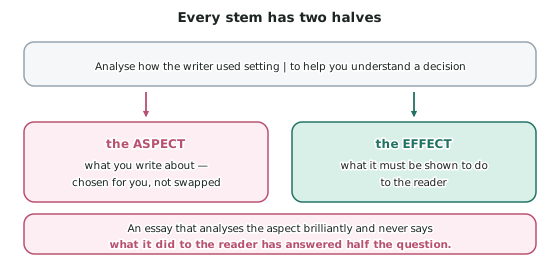
- Written text usually ties an aspect to a meaning. A visual or oral text ties it to what the text does to you. The recurring verbs are manipulate, provoke, encourage, take sides, fulfil or ruin expectations.
- This changes the last sentence of a paragraph. …which shows the character is isolated stops at meaning; …so we are placed outside the room and share the discomfort of watching reaches the audience.
- It makes your own reaction usable — but only anchored to the choice that produced it.
Three demands an essay has to meet
- Analyse means explore and interpret how meanings and effects are created, in essay format. Every essay here does this much.
- Reasoned and clear comes on top of it, and the majority of your interpretations have to connect to each other rather than sit side by side.
- Insight or originality is the last, and it is not more of the first two. Length and technique-counting cannot produce it.
- The rest of this topic uses these three demands without restating them.
The four aspect categories
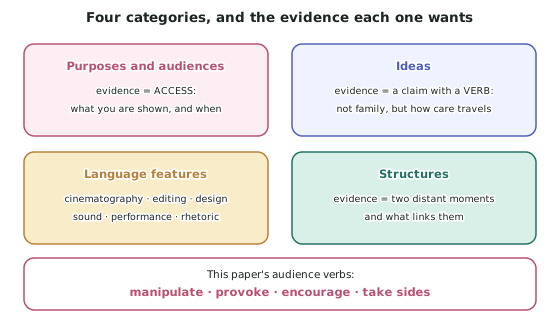
- Structure is the least crowded category, and it suits a text in which nothing can be quoted.
- A topic cannot be analysed, because every scene supports it equally. Family is a topic; in this family care is expressed through work rather than speech is an idea.
- Every paragraph stays on, and ends on, one aspect. Crossing into the other categories is support, not a change of subject.
Worked Example
Scene — "The Kitchen", written for this site so it can be analysed in full. Late afternoon. Mere, 16, has come home to tell her father she is leaving for Auckland.
Shot 1 — wide, static, from the far doorway: Mere just inside the door, her father at the table with his back to her, peeling potatoes, the table between them. Held eleven seconds. No music, only the peeler. Shot 2 — mid shot of the father, still from behind; he does not turn. Shot 3 — close-up of Mere; she opens her mouth, then closes it. Two seconds. Shot 4 — the wide shot again, identical framing to Shot 1. Mere says, "I've got the bus at six." The peeling stops. Silence. Shot 5 — close-up of the father's hands, motionless on the potato. Shot 6 — wide, held. He says, "There's kai in the oven." The peeling resumes. Fade to black.
Show how one scene answers a question from each of the four categories.
Purposes and audiences — Analyse how a text positioned its audience in relation to a character. The camera never takes the father's eyeline: we are given Mere's face and the father's hands, so the scene grants access to one person and denies it to the other, placing us in the doorway of a family we do not belong to.
Ideas — Analyse how an idea was developed through a character. In this house care travels through work rather than speech — he peels through his daughter's arrival, stops at her announcement, resumes under his reply. Three uses of one prop.
Language features — Analyse how sound was used to manipulate the viewer's response. There is no score anywhere in the scene, so the viewer must read a domestic noise instead, and when the peeling stops that silence is the loudest event — manipulation by subtraction.
Structures — Analyse how the structure of part of a text created an effect. Shots 1, 4 and 6 are the same wide static shot, so the most significant announcement of Mere's life leaves the picture exactly as it found it.