Structuring the submission, and reaching Merit and Excellence
Organise by response, not by text
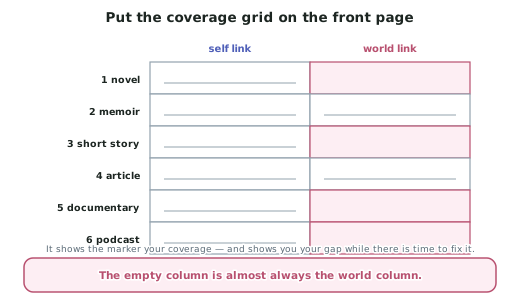
- Schools set this standard up differently — a portfolio, a reading journal, a recorded discussion, a presentation. The content requirements are identical in every case, and three things must be visible: the count, both link types, and evidence attached to every response.
- The single most damaging structural decision is a section per text. It produces six mini-reviews, almost automatically:
- A section headed with a title invites you to introduce the text, which invites summary.
- It gives no reason to bring two texts into contact, so nothing is more than one text deep.
- It makes the weakest text take up as much room as the strongest.
- Organise by response instead. A section covers a response you had, and draws on whichever texts produced it — texts that made me revise something I thought I knew, where I disagreed with the text and why.
- Two texts in one section is a strength — but this is not AS91104. This standard does not assess connections, so do not build an argument about the relationship.
Weighting, and making the links visible
- The two extended texts should carry the most — two or three developed responses each. A short text may carry one, and one good response is enough for it.
- Even coverage is a mistake, not fairness. Six equal sections cap your strongest material at one sixth of the submission. Every text still needs at least one developed, evidenced response, or your count is at risk.
- A marker should not have to hunt for the two link types. Either label them at the point of use, or table them in a one-page grid at the front: rows are texts, columns are self link and world link, one line per cell.
- The grid finds your gaps before the marker does. An empty column tells you which half you have avoided — and it is almost always the world column.
- Do not manufacture the missing half at the end. Go back to the text with the most checkable context and build it properly.
- File quotations as you read, from the log. Three to ten words, introduced with a role rather than a plot summary. For visual and oral texts, a timecode and a description do the work of a quotation — at 03:12 the camera holds on the wall for eighteen seconds with no commentary is checkable, which is what makes it evidence.
Merit: the three demands
- Reasoned — the response follows from the evidence and the reader can see the path. The mechanism is where reasoning lives, so a response without one cannot be reasoned.
- Clear — the reader can tell what your response is, what caused it and what it changed, without re-reading. Clarity here is mostly order: response, trigger, mechanism, consequence.
- Informed — you know something beyond the text and have used it. This is the demand students miss. It is satisfied by the text-to-world link done properly: a named context and one checked fact. Six self links and no checked context is reasoned and clear and not informed.
- The diagnostic: was anything in the submission difficult? If nothing was checked and no belief changed, the submission records what you already thought — which reads as thin even when the writing is good.
- Merit is a property of the submission, not your best paragraph. The weak point is texts three and four, so start revising at text four.
Excellence: the trap, and the routes
- The trap is that sincerity is mistaken for the criterion. A completely honest response can be entirely unperceptive. The question is not whether the response is true but whether it notices something.
- Five routes to an insightful response:
- Respond where your reaction did not match the text's apparent intention — the sympathetic character you found irritating.
- Run the link to a belief, not to a memory. This reminded me of my grandmother stops; I had treated her calm as evidence of how she felt, and I no longer do is a change.
- Notice the text's construction, not only its content — a passage that tells you nothing about a character's interior because the narrator could not have known it.
- Use difference as well as similarity, which almost nobody does.
- Combine both link types in one paragraph — a changed personal belief about something that is also a social or political question.
- Five substitutes markers recognise: more reading (six is a floor; there is no credit for eight); more serious books (difficulty is not insight, and prestige selection produces summary); more disclosure (the criterion is perception, not exposure); stronger emotional language; and a larger claim, where the claim grows and the evidence stays the same size.
- Insight still has to be evidenced, and a claim about construction needs the pattern shown in two places — one instance is a coincidence, two is a technique.
- You do not need six insights. Three or four responses that genuinely notice something, evidenced, is what an Excellence submission looks like — put them on the extended texts.
Worked Example
Worked Example
A response to the memoir passage below, written for this page. Treat it as an extended text — a memoir about a childhood on a river.
At Achieved.
Diagnosis. Reasoned? Partly — you can tell he is worried is asserted from nothing. Clear? No — intensity stands in for the response. Informed? No, and there is no quotation.
At Merit.
What made it Merit: reasoned (claims traced to specific words), clear (four parts in order), informed (a named context, one checked fact, and what the text does with it — leaves it out).
At Excellence — one addition, about construction.