Choosing your six texts and reading for response
The count, and why it is the easiest mark to lose
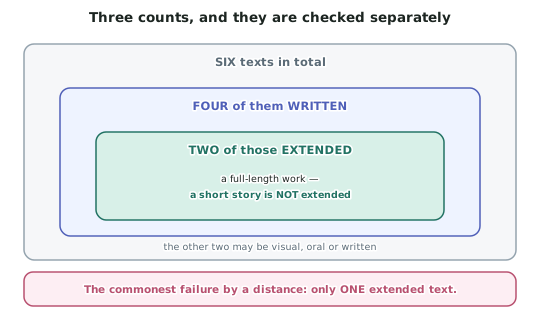
- This is arithmetic, not judgement. Six excellent responses to five texts do not meet the standard.
- The count fails three ways: too few texts, too few written texts, or only one extended text.
- Write the count down and put it in your submission, before you start writing responses, while there is still time to fix a gap.
- Do not confuse this count with AS91104's, which needs four texts.
What extended means
- Extended means a full-length work — a novel, a substantial non-fiction book, a full-length play.
- A short story is not an extended text. Neither is a poem, an article, a chapter or an essay, however good.
- A collection is not automatically extended. The text you responded to is usually one story in it. A collection counts only if you respond to it as a whole, which is harder, not easier.
- If you have to argue that a text counts as extended, choose a different text.
What independently read means
- Independently read means you chose it. That is the whole test.
- A class text does not count, even if you loved it and even if your responses to it are your best.
- A recommendation does count — from a friend, a librarian or a teacher speaking to you personally — because the decision to read was still yours.
- Record where each text came from, one clause per text.
Choosing a set with range
- Range beats prestige. Six texts of the same kind produce six versions of the same response.
- Vary four things: form (novel, memoir, documentary, article, play, podcast), subject, distance from you, and period.
- Three texts every set should contain:
- One you expect to disagree with — disagreement forces you to say why, and admiration never does.
- One with an obvious connection to your life, so one link is easy and can be pushed deep.
- One with no obvious connection at all, where the link has to be found rather than assumed.
- Include a New Zealand text on purpose. The world link is far easier to make specific when the world can be checked — a law, a Stats NZ figure, a council decision.
Reading for response: what to notice
- Read for your own reactions, not for themes. Your reaction is the only thing nobody else could have written.
- Five reactions are worth stopping for: surprise, recognition, disagreement, discomfort, and boredom at a moment clearly meant to matter.
- The last one is the most valuable and the least recorded. Students suppress it because it reads as a wrong answer. It is not an answer at all — it is evidence about what the text did and did not do.
The three-part note, and the log
- One page of log per text, started before you begin reading. Header: type, extended or not, where you found it, dates.
- Stop three or four times a session and write three things. It takes forty seconds.
- The page or moment — a number and three or four words of the line, enough to find again. A timecode does the same job for film or podcast.
- The reaction in your own words, however rough. Annoyed at her. Went cold.
- What you brought to it — what you assumed, expected or already knew before that sentence.
- The third part is the one everyone skips, and it is the one that becomes a text-to-self link. A reaction with no prior belief attached is a feeling; with one, it is a change.
- Footer, written within a day of finishing: what the whole text left you with, and — separately — what you believed before reading it, and whether that survived.
- Do not tidy the notes, and do not skip logging a text you dislike. A polished note is already an interpretation, and the disliked text usually produces the best material.
Worked Example
Worked Example
A student brings this set to a check-in three weeks before the due date.
| # | Text | Type | Extended? |
|---|---|---|---|
| 1 | Novel — two brothers, a fishing boat | Written | Yes |
| 2 | Short story — a night-shift cleaner | Written | No |
| 3 | Documentary — a coastal town, a sea wall | Visual | — |
| 4 | Podcast series — a court case | Oral | — |
| 5 | Long article — the price of housing | Written | No |
| 6 | Film — a family moving cities | Visual | — |
Does the set meet the requirement? If not, what is the smallest change that fixes it?
Do the three counts separately.
- Total: six. Passes.
- Written: three — novel, short story, article. Fails; four are required.
- Extended: one — the novel. Fails; two are required.
So the set fails two of three counts while looking varied.
The repair is a substitution, not an addition. The set already has six, so adding makes the reading load worse without fixing the structure. Replace one non-written text with a second extended written text.
Which one to drop. Rank by what each earns. The documentary carries a real coastline, so it gives a checkable world link; the podcast is built on an argument, so it is the easiest to disagree with. The film is the most replaceable. Swap it for a memoir — a full-length work, so extended. The counts now pass: six, four written, two extended.
Then check range, separately. Six forms and six subjects — strong. But every text is contemporary, so nothing offers the gap between when a text is set and when it was written.