The two links, and making a response developed
The two links the standard requires
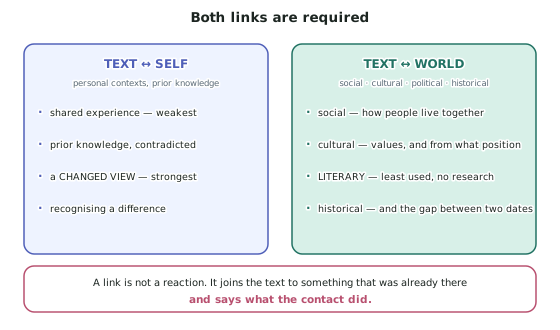
- Both are needed. A response that is only personal reaction does not meet the standard, and neither does one that is only context.
Text to self: four kinds, ranked
- Shared experience — the text describes something you have lived. The weakest if left at I could relate, and only worth writing when your case differs in a detail from the text's.
- Prior knowledge — you already knew something and the text confirmed, extended or contradicted it. The contradiction case is the strongest: you have to decide who is right.
- Changed view — you believed something before reading and something different afterwards. The most valuable link available, because it is the only one that proves the text did something. It needs the before state, which is why the log's footer question exists.
- Recognition of a difference — the text describes an experience unlike yours and clarified your own by contrast. Rare, and it works best on the text with no obvious connection to your life.
- You are not required to disclose anything private. The last three all work with no personal history at all.
- The failures: assumed similarity (I could relate) — find the difference; association (this reminded me of a holiday) — ask what the text changed; generic relatability (anyone could relate) — the word anyone removes the person, which is the one thing the standard wants.
- The fastest test: could someone who had not read the text have written this sentence? If yes, it is not a link.
Text to world: five routes, and making them specific
- Social — how people live together: class, work, family structure, who is included and who is not. Cultural — values, beliefs and practices, including how a text represents a culture, and from what position.
- Literary — how the text relates to other texts: a convention it follows or breaks. The least used route and often the most impressive, because it needs no research.
- Political — power: who has it, who is subject to it. Not party politics. A decision about a road is political; so is who gets to speak at a dinner table.
- Historical — the period the text is set in, the period it was written in, and the gap between them. A text set in the 1950s and written in the 1990s is a 1990s view of the 1950s, and what it notices belongs to the later date.
- Name the thing. Not society but a law, a period, a policy, an institution. Check one fact — a date, a figure, the name of a mechanism. One is enough, and Stats NZ, the legislation website and Te Ara make NZ contexts easiest to verify.
- Say what the text does with the context — endorse, criticise, complicate, or record without comment. The last is the case students never name: presenting something contested as ordinary is a claim, not neutrality.
- Use the silences. A story about a house being taken that never mentions compensation tells you which currency it thinks the loss is in.
What developed means
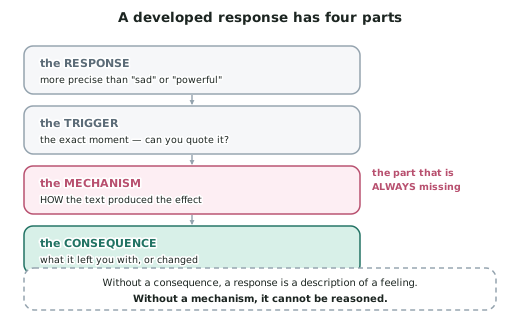
- A stated response names a reaction. I found the ending sad. It can be perfectly true and worth no marks, because nothing in it can be argued with, checked or built on.
- Writing the mechanism means looking at the text's choices, not at your feelings: the words used and the ones not used; the order things arrive in and what is delayed; what is withheld — a number, a name, a reaction the text refuses to describe; and who is telling it, and what that person could actually know.
- The consequence proves the response. A changed belief, a re-read of an earlier chapter, an assumption you can no longer make.
Evidence, and why a response is not a review
- Supported by evidence is in the title of the standard. Three kinds, strongest last: a short quotation (three to ten words); a precisely identified moment — chapter, scene, timecode; and a count, a placement or an absence with a boundary — money is never mentioned in a passage entirely about a property transaction.
- Quote the small things. A three-word action is usually better evidence than a speech, because you have to explain why it matters — and that explanation is the mechanism.
- A review judges the text; a response examines what the text did. Evaluation of quality earns nothing — gripping, the ending was disappointing, I'd recommend it.
- A response to a text you thought was badly made can score just as highly, because you have had to work out why it failed to do what it attempted.
- If a marker could reconstruct the plot from your submission, the wrong thing has been written.
Worked Example
Worked Example
The extract below was written for this page, so it can be quoted freely. Treat it as a passage from an extended text.
Build a text-to-self link and a text-to-world link on this passage.
Self, failing version. My grandparents love their house too, so I could relate to how sad Nan must feel. Rejected — no moment, no prior belief, and it survives without the text.
Self, developed — a changed view.
The detail I could not get past is that she "put it under the fruit bowl". I expected grief and the passage gives grief, but it is administrative — she does not cry or protest, she files the letter where it will not be seen. I had read my own grandmother's calm about selling her house as evidence that she did not mind. Nan agreeing that the road is "About time" is the same behaviour, and here it is clearly management rather than indifference. I no longer think calm is evidence of feeling.
Why it works: a quoted action as the trigger, a mechanism (grief as filing), and a consequence about the real world.
World, failing version. This shows how society treats older people badly. Rejected — nothing named, nothing checked.
World, developed — the political route.
The passage is about a compulsory acquisition for a road. In New Zealand, land can be taken for a public work under the Public Works Act 1981, with compensation payable. The text never mentions the Act, the compensation or the process — it all arrives as one letter, and the letter goes under a fruit bowl.
That choice is the argument. The law treats the matter as complete once notice is served and money is paid; the passage measures the same event in fifty-one years and a decision about who to ring, and records the two currencies side by side without editorialising.
Why it works: one named law, one checked fact, most of the length spent on what the text does with it, and a silence — the absent compensation — read as evidence.