Convincing, and commanding attention
Merit: reasoned, clear and sustained
- Merit is convincingly, and the standard unpacks it as reasoned, clear and sustained. The three are separable, and a speech usually fails one of them rather than all three.
- Reasoned — each movement does something the previous one did not.
- The test: for each movement, name what the audience now knows that they did not before it. If you cannot, the movement is decoration.
- Three points that each say this decision was bad is one point with three examples. The audience feels the repetition even if they cannot name it.
- Clear — the audience understands each sentence as it lands, first time.
- The check: deliver it to one person and ask them to tell you the argument back. What they leave out is what was unclear, and it is almost never what the speaker expected.
- Sustained — the quality does not drop. This is the one most often missing.
Why speeches sag, and where
- Sustained is a claim about duration, not intensity. It asks whether the crafting and the control are still present at two minutes thirty, in both halves: is the later material as concrete, and is the pace still varied and the head still up?
- The reason most Merit attempts fail here is structural, not personal. Speakers write from the beginning, rehearse from the beginning, and are most alert at the beginning — so the best material, best delivery and best preparation all land in the first forty seconds.
| Symptom in the middle | Usual cause |
|---|---|
| Delivery goes flat | That section has been rehearsed least |
| The audience stops tracking | The movement has no concrete anchor of its own |
| The speaker's head goes down | The card carries the most content and the fewest written phrases |
| Points feel repetitive | The middle restates the opening instead of developing it |
- The last is the substantive fault. A speech can sustain by repeating rather than by developing, and still fail Merit.
- We were told it was temporary. We were told it was a trial. — repeated phrasing, new content. Credited.
- It is unfair. It really is not right. It is just not fair on the families. — one idea, three costumes. Not credited.
- Fix a sag in this order: give the weak movement a concrete anchor; check it develops and cut it if it does not; rehearse from the middle for two run-throughs; reload the card; and mark a delivery change into it. Two developed movements beat three, one of which is soft.
Excellence: commanding attention
- Excellence is effectively, glossed as an oral text that commands attention. The production standards use this where the analysis standards use perceptively, which moves the test from the page to the room: it is a claim about what actually happened in front of the audience.
- The uncomfortable consequence. A speech can be well argued, technically correct and still not command attention.
- The encouraging one. Attention comes from a small number of identifiable mechanisms. It is not charisma, and none of them requires confidence.
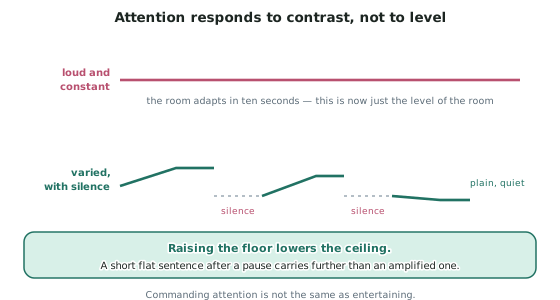
- The five mechanisms:
- Something to picture in the first ten seconds. Forty-one kids in the learn-to-swim class is attended to; the importance of community facilities is not, however true.
- Variation in pace, volume and tone — the most reliable single difference between a Merit and an Excellence delivery.
- Silence. Two seconds makes a room look up, because a break in the pattern is checked automatically.
- Restraint. A short, flat sentence after a pause carries more than an amplified one, because an audience believes a conclusion it reached over one it was handed.
- Being watched rather than watching. Sustained eye contact on individuals converts a performance into an address.
- What does not work: more devices; volume, because the room adapts and you lose your headroom; a more dramatic topic, since specificity rather than scale holds a room; memorising word for word, because retrieval flattens the tone; and emotive vocabulary — devastating, heartbreaking — which names the response instead of producing it.
- Commanding attention is not entertaining. A speech can hold a room while being sombre, quiet and slow. The two demands converge at the pause before the plain sentence — the most restrained moment in the speech and the moment the room is most certainly listening.
Worked Example
Worked Example
Two closings for the same three-minute speech, written for this page. The speech argues against the closure of a small-town pool, and it opened with There were forty-one kids in the learn-to-swim class at our pool last summer.
Evaluate the two against commands attention.
Closing A — why it fails.
- It names the response it wants — devastating, heartbreaking, shocking. A listener told what to feel evaluates the instruction rather than feeling it.
- It runs at one level throughout, so nothing is marked, and after ten seconds the maximum is simply the level of the room.
- It summarises, sending the audience back to material they already have, and Thank you for listening makes politeness the final content.
- It contains no detail at all. Nothing in it could not be said about any closure anywhere.
Closing B — what each choice does.
| Choice | Mechanism | Why it works |
|---|---|---|
| Opens on sixty-one thousand dollars | Concreteness | A number, not a judgement. The audience does the arithmetic |
| Two-second pause after it | Silence | The figure sits alone; a break in the pattern makes the room look up |
| One intersection, resurfaced | Antithesis, restraint | The comparison delivers the judgement without stating one |
| Forty-one kids, returning | Repetition of the anchor | The opening detail comes back with its meaning changed; the frame closes |
| Slow and quiet on that line | Variation, restraint | A drop, not a rise. The audience leans in |
| Question held on one face, then stopping | Being watched, silence | The last sentence goes to one person and is left unanswered |
The comparison that matters. Closing A is longer, louder and more emotional, and it commands less attention. Attention responds to contrast, and A has none — no silence, no variation, no baseline, no specific detail for anything to stand out against.