Writing for the ear, and a shape a listener can hear
An oral text is heard once
- An oral text is received once, in order, at a speed the listener does not control. Every rule on this page is that one fact restated.
- A reader can go back over a hard sentence. A listener cannot, so every sentence must be understandable at the moment it lands.
- A reader sees the shape of the argument — paragraphs, headings, white space. A listener sees none of it, so structure has to be audible or it does not exist.
- The consequence: do not write an essay and read it aloud. It is the commonest way this standard is failed. An essay is not a weaker speech; it is a text built for conditions that are not present.
What changes when you write for the ear
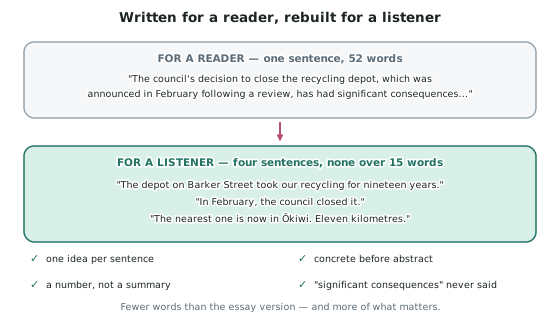
- Shorten the sentences, and vary their length. One idea per sentence is the working rule, and a three-word sentence after a long one is the loudest thing in a speech.
- Put the concrete before the abstract. Written argument runs claim-then-evidence; in speech the abstract sentence is gone before it means anything, because the listener has nothing to attach it to.
- Repeat on purpose. Repetition is a fault in an essay and a tool in a speech — it is how a listener holds an argument they cannot re-read. Repeat phrasing, not ideas.
- Signpost aloud. That is the first problem. The second is worse. Spoken signposts replace the paragraph breaks the audience cannot see.
- Prefer plain words to impressive ones. An unfamiliar word stops a listener mid-sentence and they miss the next one.
- Cut every sentence that only manages the audience — as I mentioned earlier, moving on to my next point. Replace them with a pause.
Choosing a topic, audience and purpose
- Choose something you have a genuine stake in. Investment cannot be added at the delivery stage, and an indifferent speaker is visible within fifteen seconds.
- Narrow it. Three minutes holds one argument developed, or four points listed. If your best detail is a statistic anyone could look up, the topic is still too wide.
- New Zealand material is concrete by default — a council decision, a closure in your town, a change to your school or region.
- You know your audience exactly. Ask what they already know (anything you explain that they know is spent time), what they will resist, and what they can picture.
- Fix one purpose — to persuade, inform, move or entertain. The purpose decides the ending: a persuasive speech ends on a demand, a reflective one on an image.
Structure has to be audible
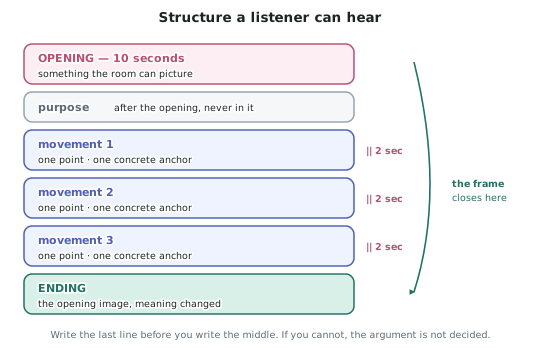
- The opening has about ten seconds, and the audience decides on concreteness, not on importance.
- Openings that work: a specific image the room can picture; a short anecdote stopped before it explains itself; a question the listener answers in their head, once; a surprising fact stated flatly, followed by a pause.
- Openings that fail: Today I am going to talk about…, which spends the ten seconds announcing rather than earning; a dictionary definition; and an apology, which instructs the audience to expect less.
- A movement is a section with one point in it. Fewer than three usually means the argument is not developed; more than four and each gets under forty seconds, so none of them lands.
- Order the movements deliberately. Escalation — each point costs more than the last. Narrowing — from the general situation to one person. Objection last — your points, then the strongest argument against you, answered.
- Give each movement a concrete anchor — one image, number or moment belonging only to it. A movement with no anchor is where an audience drifts.
- Do not announce the plan. I will discuss three things is a contents page, and a listener cannot use one. Signal each movement as you reach it.
- Transitions are said aloud, and the strongest is silence: two seconds does more than any linking sentence, because the audience uses the gap to file what they just heard.
- Plan the ending before you write the middle. If you cannot write the last line, you have not decided what you are arguing.
- Endings that work: returning to the opening image with its meaning changed; a short, specific call to action; one plain sentence after a pause.
- Endings that fail: trailing off; So yeah, that is my speech; a summary, which returns the audience to material they already have.
- Memorise the first and last lines exactly. They fall where nerves are worst and where the words matter most.
The first test of any draft
- Read it aloud, standing, at full volume. This is a construction test, not a rehearsal. Anything you stumble over is badly built, anything you have to re-read will be lost entirely, and anywhere you run out of breath needs splitting.
- Silent reading finds none of these. The page conceals exactly the faults the ear exposes.
Worked Example
Worked Example
Two plans for the same three-minute speech, written for this page. The topic is a proposal to close the last Sunday bus route into a small town.
Diagnose Plan A, then rebuild it.
What is wrong with Plan A.
- The opening explains before it earns. The proposal is administrative detail; nobody has been given a reason to care.
- The three points are categories, not movements. Each will be a general claim about a group, with no anchor.
- They are in no order. Nothing changes between point 1 and point 3, so the speech accumulates rather than builds.
- The ending summarises, then makes a request too vague to act on.
Plan B — same argument, audible structure.
| Part | Content | Why |
|---|---|---|
| Opening | Marama Toko is seventy-one. On Sundays she walks to the hospital. It takes her two hours and ten minutes. Pause. | A concrete image in the first ten seconds; the proposal is not mentioned yet |
| Purpose | In November the council votes on the Sunday bus. I want to talk about what a bus is for. | Purpose arrives after attention, and reframes the vote as a question of principle |
| Movement 1 | The council's own case: eleven passengers a trip. Stated fairly. | Objection first — the room hears its own doubt spoken, so it trusts the rest |
| Movement 2 | What eleven means: not eleven trips saved, but eleven people with no alternative. One is Marama. | The complication — the number is true and the conclusion drawn from it is not |
| Movement 3 | The route's cost, set against a taxi contract for those eleven. Two-second pause into the close. | Escalation: the most specific material last |
| Ending | Two hours and ten minutes. That is what a bus is. Not a service the council runs — a Sunday somebody gets back. | Returns to the opening figure with its meaning changed |
What the rebuild changed. The content is nearly identical — nothing was researched. The three groups became three moves (their case, its flaw, the cost), so each movement does something the last did not. The opening detail became the closing detail. And the objection moved to the front, which is the highest-risk decision here and buys the most.