Delivering: the three feature groups, cue cards and rehearsal
All three groups, together
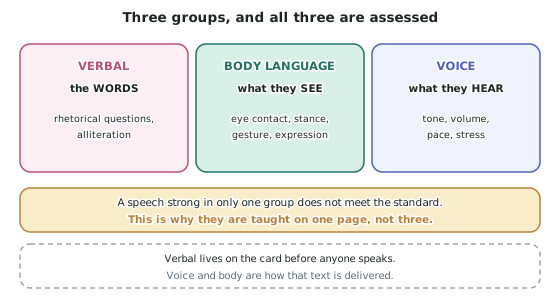
- A feature is only a craft choice if it is doing a job. Naming a device you happened to use is not craft; choosing it for what it does to a listener is — and controlled means the choice was made in advance, not felt in the moment.
Verbal features
- Rhetorical question — makes the listener answer silently, and an audience that has answered has taken a position. Cap it at two, and make the answer uncomfortable rather than obvious: Where do those forty-one kids learn to swim now? recruits; Is that fair? does not.
- Alliteration — use it on the one phrase you want remembered. Sustained, it sounds childish.
- Direct address — we assumes the audience already agrees, which is why it persuades. You is sharper: it works when it names something true of the room and fails when it accuses.
- Anaphora — repeating an opening across successive sentences: We were told it was temporary. We were told it was a trial. We were told there would be a review. Three is the natural length.
- Antithesis — two opposed ideas in parallel: Not a service the council runs — a Sunday somebody gets back.
- The deliberate short sentence, and understatement. A fact delivered flat carries further, because an audience believes a conclusion it reached over one it was handed.
- Concrete detail behaves like a device. Eleven kilometres is evidence; a long way is a summary of evidence.
- Fewer devices land harder. Devices work by contrast with plain speech — one per movement plus one each in the opening and close is five or six in three minutes.
Voice
- The named features are tone, volume, pace and stress. Add the one not on the list and mattering most: the pause. Every speaker speeds up under nerves, without noticing, which is why voice is planned on the card.
- Pace — plan to speak slower than feels natural. Slow for the sentence carrying the point, quicker through setup, slowest for the last line of a movement. Unvaried pace is the commonest voice fault, and it is what makes a good speech sound recited.
- The pause — two seconds before or after a key line is the single most effective technique available, and almost no student uses it. Place one after the opening image, at every boundary, and before the final sentence. Two seconds will feel like ten, and um or an audible breath turns it into a hesitation.
- Volume — reach the back of the room, then prefer dropping to raising. A quiet line pulls people in; a loud section removes your own headroom.
- Tone — write one word per card: plain, dry, warm. Sincerity is not a tone — students told to sound sincere produce a solemn monotone.
- Stress — I never said she took the money means four different things depending on which word is stressed. Decide one stressed word per key sentence and underline it.
Body language
- The named features are eye contact, stance, gesture and facial expression, and they start working before the first word. This is the group students believe cannot be planned, and the one where planning shows most.
- Eye contact — the most heavily weighted feature, because it converts a performance into an address. Look at individual people, holding each for a whole sentence, and finish the sentence on the face you started it on; continuous scanning reads as nerves and means nobody was looked at. Deliver the final line to one person.
- Stance — feet planted shoulder-width, weight even, still. Rocking is almost always weight on one foot. If you move, move between sentences, complete the move and stop.
- Gesture — above the waist, and it works when it follows from meaning rather than being applied on top. Repeated identical gestures become a tic, and stillness is itself a gesture.
- Facial expression — the feature that most often contradicts the words, and the audience believes the face. The nervous smile is involuntary and must be found on a recording. Keep nothing in your hands you do not need.
Cue cards, not a script
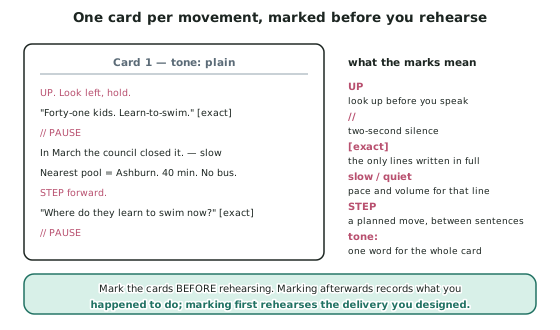
- Nothing forbids a script. Reading one costs more than it saves — it removes eye contact, occupies both hands, bends the head down and flattens the voice. One choice damages all three groups at once.
- Stiff card, not paper, because paper shows every tremor. One card in one hand so the other can gesture. Number every card, and change cards between sentences, never during one.
- One card per movement. More means extra transitions; fewer means the card has become a script.
- Keep the marking sparse — a dozen marks in three minutes, because a covered card cannot be read at a glance.
Rehearsal, and the day
- Everything assessed in the delivery half is physical, and silent reading rehearses none of it. Rehearse aloud, standing, at full volume, in a room the size of the one you will speak in.
- Four or five full run-throughs, start to finish. Fewer and the structure is not secure; many more and the delivery sounds recited.
- Record one run-through and watch it twice, looking for one thing each time. Sound off — planted feet or a rock, hands returning to rest, head up? Find the nervous smile here. Screen off — does the pace change, and how long is a pause actually?
- Time every run-through. Nerves make the real delivery faster, so cut to fit rather than speeding up. Cut setup, then the second example, then qualifications, then a whole movement. Never the pauses, the concrete details, or the last line.
- If you lose your place: stop, stand still, breathe, find the card. Do not narrate it. A silence with a still body is indistinguishable from a planned pause.
Worked Example
Worked Example
A three-minute speech on the closure of a small-town pool. Below are the student's four cue cards, written for this page, and her run-through record.
Review the cards and the recording, and decide what to change.
What the cards get right. One card per movement, numbered. Only three lines are written in full, and they are the right three — the opening, the turn and the close. Delivery cues are sparse and consistent, and the frame is visible on the cards themselves: cards 1 and 4 carry the same two lines.
What the recording showed.
- Sound off. Weight onto the left foot from card 2 and a slow rock began. Free hand into a pocket at card 3 and stayed. Head down for the whole of card 2. Expression unchanged throughout.
- Screen off. Pace flat from card 2 onward. The three marked pauses were 1.9 seconds, 0.6 seconds, and skipped entirely.
The diagnosis — one fault with six symptoms. Everything degrades from card 2 onward, and card 2 is the card with the most content and the least written on it. Reconstructing it took attention, and the attention came out of the delivery. The delivery did not fail where the speaker was nervous; it failed where the card was thinnest.
What to change. Split card 2 in two and write its first sentence in full. Add UP to cards 2, 3 and 4 — the cue exists on card 1 only, which is where the head stayed up. Move the cards to one hand. Then rehearse the pauses against a timer once, because 0.6 seconds is not a pause and no speaker can judge this from the inside.