The four categories a connection can relate to
The list is not a menu of equal options
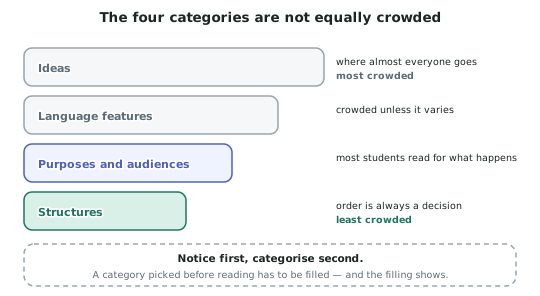
- The Explanatory Notes say a connection may relate to purposes and audiences, ideas, language features or structures. The four differ in how crowded they are, in what evidence they need, and in how reliably they produce variation.
- You are not restricted to one, and the strongest connections sit in one category and vary in another.
Purposes and audiences
- Purpose is what the text is trying to do to a reader: persuade, unsettle, reassure, implicate, sell, commemorate. Audience is who it does that to, and more usefully how it treats them — as insiders or outsiders, as people already agreeing or as people to be won over.
- Purpose cannot be quoted, so the inference must be shown. The evidence is who is addressed (a text that says we has decided its reader is already inside), what is explained and what is assumed, what the text asks for, and where it stops — because that is where the writer chose to leave you.
- The failure to avoid: the purpose of this text is to show how hard life was for the family is a plot summary wearing the word purpose.
Ideas
- Ideas in the EN includes character, theme, setting, attitudes, beliefs, experiences, feelings and opinions.
- The fix for crowding is one move: connect on the treatment of the idea, not on the idea. Not all four are set in small towns, but in all four the town is the antagonist.
- Topic versus idea. A topic is a word or phrase — war, family, belonging. An idea is a sentence with a verb — war is administered by people who will never see it. Four texts can share a topic and disagree about the idea, and the disagreement is much the stronger connection.
Language features
- Language features at Level 2 includes figurative language, syntax, style, symbolism, vocabulary and sound devices — and for visual or oral texts, cinematography, editing, sound, performance and rhetorical devices.
- Three levels, in increasing strength: all four use X (weak — most texts do) · all four use X to do the same thing (solid) · all four use X and it does something different in each, explicably (strongest, because the variation is built in).
- Mixed-form sets need a translation step. A poem's line break and a film's cut are not the same feature, so word the connection at the level of effect: not all four use short lines and quick cuts, but all four break the text into units shorter than the thought, so the reader must complete it.
- The features that reward attention are the ones a text uses consistently: syntax, naming and what a text refuses to name, and repetition of phrasing in a changed context.
Structures
- Structures in the EN includes narrative sequence, beginnings and endings, part text versus whole text, and the organisation of the material.
- The least crowded and often the most productive category. Structure is always a decision — a writer cannot avoid choosing an order — so a shared order across four texts is a shared choice, not a coincidence of subject.
- What counts: order (all four withhold the central event until late) · endings (all four refuse resolution) · proportion (forty pages to a week and one to a decade is an argument about which mattered) · omission (name what a reader would expect, and where it would have gone).
- A structural point often needs no quotation, but it needs a precise description a reader could check.
- They come with variation attached. Four texts that all withhold something withhold different things, from different people, for different lengths.
Worked Example
Worked Example
Four texts written for this page, all concerning a beach the council plans to close to vehicles.
- W — surf club newsletter. You already know what the beach is worth. You have carried a boat down it. So we are not going to argue the case here; we are going to tell you when the meeting is.
- X — radio interview, described. A woman who has fished off the beach for forty years is never asked whether the closure is right — only what she catches. The last question is "and where will you go?" She does not answer for four seconds.
- Y — short story. A boy waits in a car park counting trailers. There are nine, then eight, and by the end three, and nobody in the story mentions this.
- Z — assembly speech. Every one of you has been to that beach on a school trip. Every one of you will be able to vote in two years. I am asking you to turn up, and be counted.
Build a connection in the purposes and audiences category.
Step 1 — ask what each text wants, and how it treats you.
| Text | What it wants | How it treats the audience | Evidence |
|---|---|---|---|
| W | Attendance | As insiders needing no persuading | "You already know" |
| X | Nothing stated | As a listener who will conclude for themselves | No question about the closure; the silence is left in |
| Y | Nothing stated | As a reader who must notice unaided | "nobody in the story mentions this" |
| Z | Attendance | As people whose power is not yet real | "in two years" |
Step 2 — the split is visible. W and Z ask outright. X and Y ask for nothing, and arrange the material so the audience reaches the conclusion itself.
Step 3 — word the connection so it says what follows.
Step 4 — check the split tracks something.
- W can assume agreement (surf club members), so it skips the argument and goes to logistics. Z can assume neither agreement nor power, so it establishes shared experience first, then asks small.
- X and Y address audiences who might think anything, so asking would be counterproductive — a request would mark the text as one side of an argument and let the listener dismiss it. Withholding the request is what allows them to be believed.