Four texts, and a connection worth making
The counts you can fail without writing badly
- Four texts minimum. Not three with a passing mention of a fourth. Your teacher checks the number before reading a word of the analysis.
- At least one student selected, and it must be visible that you chose it. Say so in your introduction: the fourth text, X, is my own selection.
- Count twice — once when you plan, once when the report is finished. Texts get quietly dropped in drafting.
- Do not confuse this count with AS91106's. Personal responses needs six texts. This one needs four, one student selected.
- A text is used when it is analysed and evidenced and the argument would change if it were removed. It is only mentioned when it appears in a list and nowhere else. Cross each text out of your plan in turn: if the connection is unchanged, that text is decoration.
Choosing texts that can be connected
- Texts may be of different types, and mixing types is an advantage. A connection surviving across a poem and a film is more clearly of consequence than one between two novels by the same writer, where shared authorship explains it.
- Two texts that are too alike cost you a section. If two of your four make the same point the same way, one is doing no work.
- Choose texts you can quote. A film watched once without notes cannot be evidenced. Length is not quality — a fourteen-line poem can carry a section, because you can analyse all of it.
- Choose the student-selected text last. Study the class texts, find the connection, then find a text that extends or complicates it. Spend the slot on a job the other three cannot do: fill a gap, add a form, or supply a disagreement.
Significant means of importance and consequence
- The EN defines significant as of importance and consequence. Truth is only the entry condition.
- Importance — the connection is about something central to the texts, not incidental.
- Consequence — noticing it changes something. You read the texts differently afterwards.
- The "so what" test. State the connection in one sentence, then ask so what? If the honest answer is nothing, they just both do that, it is not significant, and no amount of good writing repairs it.
- The answer to so what becomes your conclusion, so a connection that survives the test hands you your last paragraph.
Connections that are true and worthless
| The connection | Why it fails |
|---|---|
| All four are New Zealand texts | A fact about the shelf |
| All four are about war | Tells you what the texts are on, not how they relate |
| All four use metaphor | Nearly all texts do |
| All four writers grew up in small towns | A connection between writers, and unevidenceable from the texts |
| All four made me feel sad | A personal response — AS91106, not this standard |
- Turning a weak connection into a strong one: add a verb (all four are about grief → all four locate grief in an object rather than a person); add a condition (all four use silence → in all four, silence is a chosen channel rather than a failure to speak); and name what follows — if you cannot finish and the consequence of this is…, keep rewording.
Three shapes a connection can take
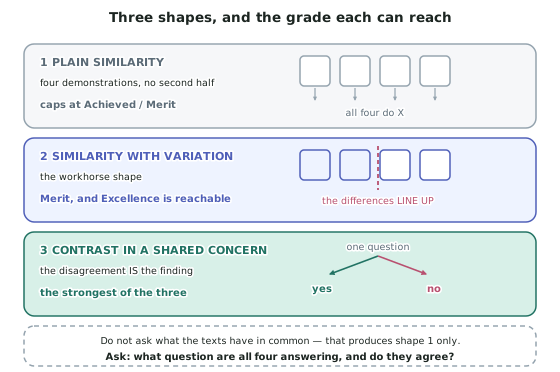
- Shape 1 is still right when the shared X is genuinely unobvious. All four texts refuse to name their central character is worth writing, because the observation is itself the finding.
- Shape 2's requirement is the pattern. All four do X differently is not a finding — texts are always different. The differences must line up: two one way and two the other, or a progression, or a difference that tracks something else.
- Shape 3's disagreement must be real and inside the texts. It is not enough that you disagree with a text. The evidence that it is real: you can point to a moment in one text that would look wrong to another text.
- The dissenting text is the most valuable in the set. Most students treat the text that does not fit as a problem to manage. Working out why it dissents usually produces the best section of the report.
- If the texts only support Shape 1, change a text — that is what the student-selected slot is for.
Worked Example
Worked Example
The four texts used throughout this topic, all written for it:
- A (story) — a woman rings her sister every Sunday; the cord wound round her finger; we hear only her half: "Oh yes," "No, he's good," "Well, we manage."
- B (film) — a father and son drive to the tip in silence, filmed from the back seat; one line, "Not like that," while they lift a mattress together.
- C (poem) — We were a family of / almost… Passed the salt instead, / and the salt did fine.
- D (memoir, student selected) — a father announces a diagnosis in the voice he uses for the cricket score, then asks who wants ice cream. Last line: "I have thought about that yes for eleven years."
Word this connection in all three shapes and decide which the texts support.
Shape 1. All four texts show families who do not say what they mean. Unarguable, and the report writes itself four times. Cap: Achieved.
Shape 2. All four substitute something ordinary and repeated for the words the family cannot say — and the substitute belongs to one person in two of them and is shared in the other two.
- One person's: A (the cord is the mother's alone), D (the father chooses the ice cream).
- Shared: B (both lift the mattress), C (the salt passes between them).
The split is two-two, so there is a pattern rather than four differences. A genuine Shape 2.
Shape 3. State it as a question first: does the substitution work?
- C answers yes — "and the salt did fine."
- D answers no, and counts the cost — "eleven years."
- A and B give no verdict; both stop before one is possible.
Check the disagreement is inside the texts. C's "did fine" is a judgement the text makes, not one imposed on it, and D's "eleven years" is the same kind of judgement pointing the other way. Each would look wrong to the other. It is real.
Which shape do the texts support? Shape 3, carrying Shape 2 inside it. The two splits do not fall on the same line — C is shared and approves; D is one person's and counts the cost — so the report can argue that the verdict depends on whose arrangement the silence is.