The grid, the report, and what perceptive looks like
The grid
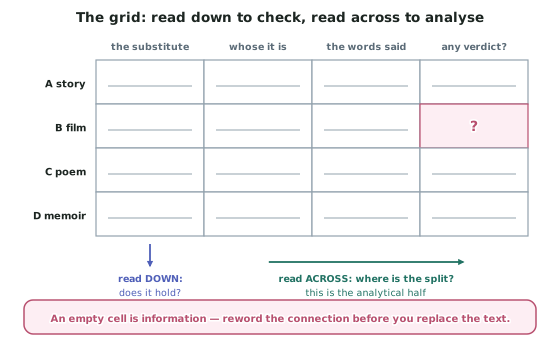
- A plan written as a list of paragraphs hides what you most need to see — whether every text supports every point.
- Rows: your four texts. Label the student-selected one now, so you cannot forget to declare it. Columns: the aspects of your connection — not the texts, and not the four categories. Three or four columns is right.
- Cells: one piece of evidence, written out — a quotation, or a described moment precise enough to check. Not a note saying has this too.
- What you are looking for is a split: two texts one way and two the other, or three and one, or a progression. If the cells differ and the differences do not line up, that column is a list, not an aspect.
- An empty cell is information. It means the text does not belong, or the connection is worded too narrowly — the commonest case, and rewording usually improves the claim — or you have not looked hard enough.
- Never fill a cell with arguably. A weak cell becomes a thin paragraph, and that is where a marker sees the evidence is uneven.
Never organise the report text by text
- Four mini-essays cannot demonstrate a connection, however good each one is. This is the commonest fault in the standard, and a synthesising conclusion cannot repair it: by then the reader has met four essays, and a final paragraph asserting a connection is a claim, not a demonstration.
- The diagnostic is reorderability. If your sections could be shuffled without damage, they are four separate analyses. The second diagnostic: if your section headings are text titles, replan before you draft.
The structure that works
- Introduction. Name the four texts and their makers, state which one is student selected, state the connection in one sentence, and say briefly why it is significant. Do not summarise the texts.
- Section 1 — establish the connection with evidence from all four. Keep it short. If it is your longest section, the report has spent itself proving something nobody disputes.
- Section 2 — the variation or contrast, and what pattern the differences form. This is the longest section.
- Section 3 — what follows that reading any one text alone would not show.
- Conclusion — the consequence, the so what, stated plainly.
- Each section comes from a column of the grid, and each row supplies its evidence — which is why every section can quote all four texts.
Writing a section, and evidencing it
- Open with the aspect, not with a text. Where the earlier texts leave the substitution unjudged, two of the four deliver a verdict — not In Text A, the mother…
- Move between texts inside the paragraph. A paragraph that mentions one text is a paragraph about one text, whatever the heading says. End every section on the connection.
- Use connectives that argue — whereas, by contrast, the exception is — rather than similarly and also, which add rather than argue.
- Evidence from every text, for every point — supported by evidence is in the standard's title. One or two pieces per text per point.
- Evidence you cannot quote is still evidence, and mixed-form sets depend on it: a described moment (the camera stays in the back seat, so we never see either face), a count, a placement, or an absence with a boundary.
What perceptive looks like
- The difference between Merit and Excellence is not the amount of evidence: a thorough report on an obvious connection is Merit.
- This standard has an advantage the single-text standards do not, and most students never use it: the comparison is an instrument. Placing texts side by side reveals what is invisible in each alone.
- Five places insight is available, and every one is a relation rather than a better observation about a single text.
- The connection that resolves into a disagreement, which converts the texts from illustrations into participants.
- The outlier that reframes the group — the text that fits the connection but behaves differently within it exposes what the rule depends on.
- A connection at the level of technique rather than content. All four are about isolation is content; all four withhold the central event until late, so the reader judges the characters before they have the facts is technique.
- A connection that includes the reader. If all four withhold emotional statement, the reader is placed in the same position as the characters: the technique enacts the subject.
- The text that supplies the group's verdict — sometimes one text states outright what the others only perform.
- Substitutes markers recognise: more texts; more quotations; a more unusual set of texts (originality belongs in the connection, not the selection); a more extreme reading; and a synthesising conclusion bolted onto a text-by-text report.
- Three habits that produce insight: draft the connection, then deliberately look for the text that resists it; word the connection as a claim someone could dispute; and ask what each text would look like if you had read only that one — the gap between that reading and your reading after the comparison is exactly the consequence the EN asks for.
- The caution. A pattern claimed across four texts must be visible in all four. The commonest way an ambitious report loses marks is a strong reading evidenced unevenly. If one text is missing, state the limit — the memoir is the exception here, and the exception matters because… A declared limit reads as control; an undeclared gap reads as a hole.
Worked Example
Worked Example
The four texts used throughout this topic: A (story, the Sunday phone call), B (film, the tip), C (poem, the salt), D (memoir, student selected, the ice cream).
Build and test the grid, then take the finding from Merit to Excellence.
Attempt 1 — worded too narrowly.
A gives the telephone cord, C the salt, D the ice cream — and B's cell is empty, because the mattress is being thrown out rather than kept, and B's real substitute is the shared lifting. The repair is not to drop B, which fits the spirit exactly.
Attempt 2 — reworded.
Broader in one respect (routines now count), more specific in two (ordinary, repeated).
Attempt 3 — the full grid.
| The substitute | Whose it is | The trivial words | Does the text judge it? | |
|---|---|---|---|---|
| A | The cord; looking at the window | The mother's alone | "Oh yes," "No, he's good" | No |
| B | The shared lifting of the mattress | Shared | "Not like that." | No |
| C | Passing the salt | Shared | (an absence — the poem records what was not said) | Yes — "the salt did fine" |
| D | The ice cream; the unchanged voice | The father's alone | "who wanted ice cream" | Yes — "eleven years" |
Read down. Columns 1, 2 and 4 hold across all four. Column 3 holds in three, with C's cell recording an absence — legitimate evidence, but different in kind.
Read across. Column 2 splits A and D (one person's) against B and C (shared). Column 4 splits A and B (no verdict) against C and D (a verdict) — and the two verdicts disagree. The splits cut across each other, which is the most useful thing the grid shows.
The Merit finding. All four texts substitute an ordinary object or routine for the words a family cannot say; in two the substitute belongs to one person, in two it is shared. Accurate, evidenced, organised by aspect — and it describes a pattern and stops.
Taking it to Excellence.
Then add the reader. All four texts withhold emotional statement from the reader as well, so we are made to read feeling off cords, mattresses, salt and ice cream — exactly as the families do. The technique enacts the subject.
Then check the evidence survives the bigger claim. Ownership split: all four ✓ · reader claim: all four ✓ · verdict split: C and D only, so it must be stated as holding for the texts that judge.
Then declare the limit. Only two of the four deliver a verdict; that A and B stop before one is possible is itself consistent with the pattern, since neither substitute is anyone's to answer for.