Standardising solutions and collecting quality data
Why standardising is named in the criteria
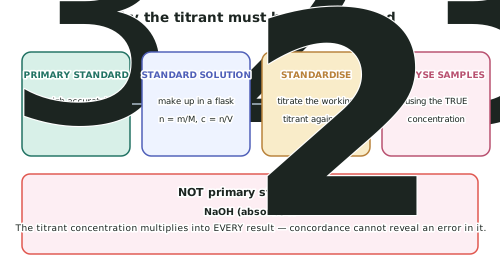
- Merit requires the collection of quality data which includes standardising the standard solution(s). It is written into the criterion, not implied.
- The reason is arithmetic: the titrant's concentration is a direct multiplier in every result you calculate.
- A titrant 3% weaker than assumed makes every result 3% low, uniformly. Concordant titres will not reveal it, and repeating will not remove it.
Primary standards
A primary standard can be weighed out to make a solution of accurately known concentration. It must be pure, stable in air, of high molar mass, and soluble.
| Substance | Primary standard? | Used to standardise |
|---|---|---|
| Anhydrous sodium carbonate, Na2CO3 | Yes | acids |
| Potassium hydrogen phthalate (KHP) | Yes | bases |
| Potassium iodate, KIO3 | Yes | thiosulfate (via liberated iodine) |
| Sodium oxalate, Na2C2O4 | Yes | permanganate |
| Ammonium iron(II) sulfate (Mohr's salt) | Yes | permanganate, dichromate |
| Sodium hydroxide | No | absorbs H2O and CO2 |
| Sodium thiosulfate | No | slowly decomposes; bacteria attack it |
| Potassium permanganate | No | oxidises traces of organic matter; decomposes in light |
| Iodine solution | No | iodine sublimes; iodide is air-oxidised |
- Note how many of the useful redox titrants are not primary standards. Permanganate, thiosulfate and iodine all need standardising, and all three are common choices for this standard.
Standardising permanganate against sodium oxalate
- Sodium oxalate is weighed accurately, dissolved, acidified and warmed to about 60 °C, then titrated with the permanganate:
- Warming is required because the reaction is slow at room temperature — the first few drops decolourise only sluggishly until enough Mn2+ has formed to autocatalyse it.
- Justifying that warming step in relation to the reaction occurring is exactly the kind of Excellence-level explanation the criteria want.
Controlling significant variables
- In a trend investigation, everything except the independent variable must be held constant, or a difference between samples could be caused by something other than the trend.
| Variable | Why it must be controlled |
|---|---|
| Titrant concentration | one standardised batch throughout; a change mid-investigation makes early and late samples incomparable |
| Sample mass or volume | the same pipette or the same weighed mass for every sample |
| Time between preparation and titration | many analytes decompose; a varying delay creates a false trend |
| Temperature | affects both solution volumes and reaction rates |
| Acid concentration | redox half equations consume H+; too little acid changes the products |
| Endpoint judgement | the same person, the same criterion, the same white tile |
| Sample homogeneity | blend or mix so each aliquot represents the whole sample |
- The two that most often produce a false trend are titrant drift and varying delay before titration, because both change systematically over the course of an investigation whose samples are usually analysed in order.
Sufficient data
-
At least five values of the independent variable, so a trend can be distinguished from scatter.
-
Three concordant titres at each value, so each point has a reliable mean.
-
Concordant means agreeing within 0.05 mL (or your school's stated tolerance), and only the concordant ones are averaged.
-
Report all your titres, including the outliers, with a comment. Deleting data is not permitted; explaining it is.
Worked ExampleStandardising a thiosulfate solution
A student standardises sodium thiosulfate solution using potassium iodate as a primary standard. 0.1783 g of KIO3 was dissolved and made up to 250.0 mL. A 25.0 mL aliquot was acidified and excess potassium iodide added; the liberated iodine required 24.15 mL of the thiosulfate solution. Calculate the concentration of the thiosulfate. (M(KIO3) = 214.00 g mol−1)
Step 1 — Moles of iodate weighed out
Step 2 — Concentration of the iodate solution
Step 3 — Moles of iodate in the aliquot
Step 4 — Moles of iodine liberated
From the first equation, the ratio IO3− : I2 is 1 : 3:
Note that the iodide is in excess — it is not limiting, so it does not enter the calculation.
Step 5 — Moles of thiosulfate used
From the second equation, the ratio I2 : S2O32− is 1 : 2:
Step 6 — Concentration of the thiosulfate
Step 7 — Significant figures
The measurements were: mass 0.1783 g (4 sf), titre 24.15 mL (4 sf), aliquot 25.0 mL (3 sf), flask 250.0 mL (4 sf). The limiting measurement is the aliquot at 3 sf.
Answer: the thiosulfate solution is 0.0207 mol L−1. This value, not the nominal concentration on the bottle, must be used in every subsequent calculation.