Stratospheric ozone depletion
Why this matters more in New Zealand than almost anywhere
-
The Antarctic ozone hole forms each southern spring, and its edge can extend over the Southern Ocean towards New Zealand.
-
New Zealand's peak UV index is around 40% higher than at comparable Northern Hemisphere latitudes. Three factors combine:
- Lower stratospheric ozone over the Southern Hemisphere.
- Earth is closest to the Sun in the southern summer, so incoming radiation is a few percent more intense.
- Less industrial aerosol in Southern Hemisphere air, so less UV is scattered away.
-
New Zealand has among the world's highest melanoma rates, and NIWA operates one of the longest-running UV monitoring programmes in the world at Lauder, Central Otago.
-
This case study also offers something the others do not: a chemical problem that was identified, regulated and largely solved, which gives an evaluation something concrete to assess.
Step 1: the natural ozone cycle
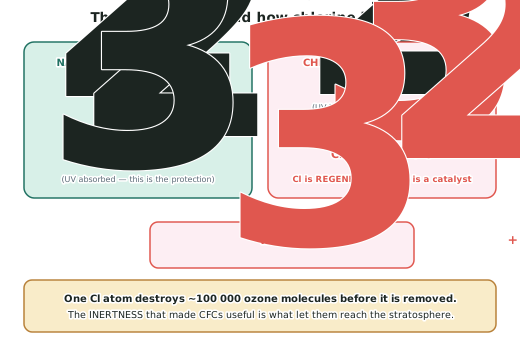
- Ozone, O3, forms and is destroyed continuously in the stratosphere, in a cycle driven by ultraviolet radiation.
Formation — UV splits an oxygen molecule, and the atoms combine with other O2:
Destruction — ozone absorbs UV and splits again:
- In an undisturbed stratosphere these processes are in dynamic balance, so the ozone concentration is roughly steady.
- The protection comes from the cycle, not from the ozone sitting there. Each time ozone absorbs a UV photon and splits, that photon's energy has been removed from the radiation reaching the ground.
Step 2: why CFCs reach the stratosphere
-
Chlorofluorocarbons (CFCs) such as CCl2F2 were developed in the 1930s as refrigerants and propellants precisely because they are extremely unreactive — non-toxic, non-flammable, and chemically inert.
-
That inertness is exactly the problem. Because nothing in the lower atmosphere destroys them, they persist for decades to over a century and are gradually mixed upwards into the stratosphere.
-
The property that made CFCs safe to use is the property that let them reach the ozone layer. This is the single most important link in the whole case study, and it is the sentence to build a report around.
Step 3: the catalytic destruction
- In the stratosphere, CFCs finally encounter UV energetic enough to break the C–Cl bond:
-
The C–Cl bond is weaker than the C–F bond — roughly 340 kJ mol−1 against 485 kJ mol−1 — so it is the chlorine that is released, not the fluorine. That bond-enthalpy comparison explains why chlorine is the problem and fluorine is not.
-
The chlorine atom then destroys ozone in a two-step cycle:
- Adding the two steps:
-
The chlorine atom is regenerated. It is not consumed, so it goes round again — it is a catalyst.
-
A single chlorine atom can destroy on the order of 100,000 ozone molecules before it is eventually removed from the cycle. That catalytic amplification is why a small concentration of CFCs could have a large effect.
Step 4: why the hole is over Antarctica
-
The damage is concentrated over Antarctica because of a combination of conditions found nowhere else:
- The polar vortex isolates Antarctic stratospheric air through the winter.
- Temperatures fall below about −78 °C, cold enough for polar stratospheric clouds to form.
- Reactions on the surfaces of those cloud particles convert inactive chlorine reservoirs into forms that release Cl atoms rapidly.
- When sunlight returns in spring, the accumulated reactive chlorine destroys ozone very quickly.
-
This is why the hole appears in September–November, not in midwinter, and why it is an Antarctic rather than a global phenomenon.
Step 5: the consequences
-
Ozone absorbs UV-B (280–315 nm). Less ozone means more UV-B at the surface.
-
UV-B photons carry enough energy to break covalent bonds in DNA, forming abnormal links between adjacent bases. Mis-repair of that damage is a route to skin cancer.
-
Other consequences: cataracts, immune suppression, damage to phytoplankton at the base of the marine food web, and reduced yields in some crops.
-
The New Zealand impact is disproportionate for the reasons given above, and it is the reason for a national culture of sun protection that visitors find striking.
Step 6: the response, and its own chemistry
- The Montreal Protocol (1987) phased out CFC production. It is the only UN treaty ratified by every member state.
- Replacements were chosen on chemical grounds:
| Replacement | Chemistry | Problem |
|---|---|---|
| HCFCs | contain C–H bonds, so they are attacked by OH radicals in the troposphere and mostly destroyed before reaching the stratosphere | still contain chlorine; transitional only |
| HFCs | contain no chlorine at all, so they cannot catalyse ozone destruction | potent greenhouse gases |
| Hydrocarbons, CO2, ammonia | no ozone effect, low warming potential | flammability or toxicity |
- The Kigali Amendment (2016) now phases down HFCs — a response to the problem created by the previous response.