Nitrogen, fertiliser and freshwater quality
Why this is the New Zealand environmental issue
- New Zealand's economy rests substantially on pastoral agriculture, and pastoral agriculture rests on nitrogen.
- Nitrate in groundwater is the most contested environmental issue in the country, particularly in Canterbury, where intensive dairying sits above shallow, permeable gravel aquifers that supply drinking water.
- This case study is unusual in that it can be argued from either of the standard's two routes: as an environmental issue (freshwater quality) or as a technology meeting a societal need (nitrogen fixation for food production). The strongest reports use both.
Step 1: nitrogen is abundant and useless
-
The atmosphere is 78% nitrogen, and almost none of it is available to plants.
-
The reason is the triple bond in N2. Its bond enthalpy is about 945 kJ mol−1 — one of the strongest bonds in chemistry.
-
Breaking it requires a large energy input, so N2 is kinetically inert: it does not react under ordinary conditions despite the atmosphere being full of it.
-
This single fact — a very strong bond in a very abundant molecule — is why nitrogen fixation was one of the central chemical problems of the twentieth century.
Step 2: the Haber process
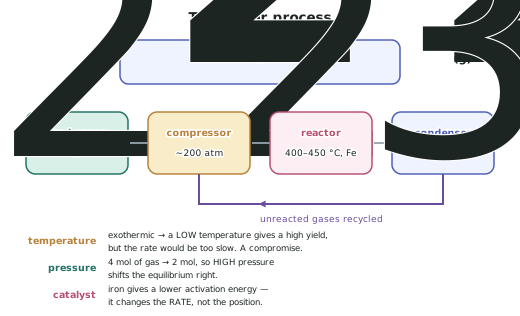
- The Haber process converts atmospheric nitrogen into ammonia:
- The conditions are a compromise dictated entirely by the chemistry:
| Condition | Value | Why |
|---|---|---|
| Temperature | ~400–450 °C | the reaction is exothermic, so a low temperature favours a high yield — but the rate would be far too slow, so a compromise is used |
| Pressure | ~200 atm | there are 4 mol of gas on the left and 2 on the right, so high pressure shifts the equilibrium right |
| Catalyst | iron | provides an alternative pathway of lower activation energy, increasing the rate without affecting the position of equilibrium |
| Recycling | unreacted gases returned | the single-pass yield is low, so recycling raises the overall conversion |
- New Zealand connection: the Ballance Agri-Nutrients plant at Kapuni, Taranaki, has made ammonia and urea from natural gas since 1982 — the country's only domestic nitrogen fertiliser production.
Step 3: ammonia becomes urea, and urea becomes nitrate
- Most nitrogen fertiliser in New Zealand is applied as urea, made from ammonia and carbon dioxide:
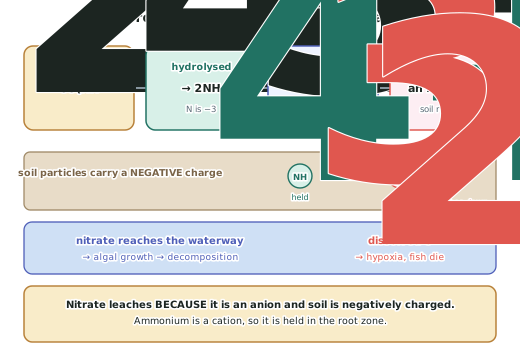
- In soil, urea is hydrolysed to ammonium:
- Soil bacteria then oxidise ammonium to nitrate, a two-stage process called nitrification:
- Nitrogen's oxidation number rises from −3 in ammonium, through +3 in nitrite, to +5 in nitrate. Nitrification is a redox process, and identifying it as one is the kind of integration this standard rewards.
Step 4: why nitrate leaches and ammonium does not
This is the pivotal chemistry, and it explains the entire problem.
-
Soil particles carry a net negative surface charge.
-
Ammonium, NH4+, is a cation, so it is electrostatically attracted to soil particles and is held in place.
-
Nitrate, NO3−, is an anion, so it is repelled by the negatively charged soil and stays dissolved in the soil water.
-
Nitrate therefore moves downwards with percolating rainwater into groundwater. Leaching is a direct consequence of the charge on the ion, and no amount of careful application changes that once the nitrogen has been nitrified.
-
The solubility rules make the same point: all nitrates are soluble, so nothing precipitates nitrate out on the way down.
Step 5: the consequences
In drinking water:
- Nitrate itself has low toxicity, but it is reduced in the body to nitrite, which oxidises the iron in haemoglobin from Fe2+ to Fe3+, producing methaemoglobin, which cannot carry oxygen.
- Infants are most at risk, and the New Zealand drinking-water standard sets a maximum acceptable value of 50 mg L−1 of nitrate (11.3 mg L−1 as nitrate-nitrogen).
In waterways — eutrophication:
- Nitrate is a plant nutrient, so elevated nitrate stimulates growth of algae and aquatic plants.
- When that biomass dies, decomposition consumes dissolved oxygen:
- The result is hypoxia — water with too little dissolved oxygen to support fish and invertebrates.
In the atmosphere:
- Under low-oxygen conditions, bacteria denitrify nitrate, and one intermediate is nitrous oxide, N2O:
- N2O is a greenhouse gas roughly 270 times more effective per molecule than CO2, and it is a significant part of New Zealand's agricultural emissions profile.