Ocean acidification: the chemistry
Why New Zealand has a stake in this
- New Zealand has the fourth largest exclusive economic zone in the world, and an aquaculture industry built on shellfish — green-lipped mussels, oysters, pāua.
- NIWA has run the Munida transect off Otago since 1998, sampling surface seawater along a line out to the subtropical front. It is one of the longest continuous ocean-acidification records in the Southern Hemisphere, and it shows a measurable decline in surface pH over that period.
- The chemistry involved — dissolution equilibria, weak acids, Le Châtelier — is exactly the Level 3 material from AS91392.
Step 1: carbon dioxide dissolves
- Atmospheric CO2 dissolves in surface seawater, establishing an equilibrium:
- The position of this equilibrium depends on the partial pressure of CO2 in the air above. As atmospheric CO2 rises, more dissolves — a direct application of Le Châtelier's principle.
- Roughly a quarter to a third of the CO2 released by human activity has been absorbed by the oceans. The ocean is not a bystander in the carbon cycle; it is the largest single sink.
Step 2: it forms a weak acid
- Dissolved CO2 reacts with water to form carbonic acid:
- Carbonic acid is a weak acid, so it ionises only partially:
- This is the step that makes the process an acidification: adding CO2 to seawater adds H+, and adding H+ lowers the pH.
Step 3: the carbonate is consumed
This is the step that matters most, and the one most often left out.
- Seawater already contains carbonate ions, CO32−. The extra H+ reacts with them:
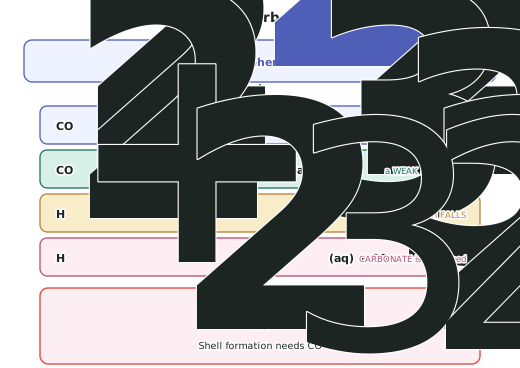
- Combining the steps, the net effect of dissolving CO2 is to convert carbonate into hydrogencarbonate:
-
So there are two consequences of adding CO2, not one:
- the pH falls, and
- the concentration of carbonate ions falls.
-
The second is the more important biologically, and it is not obvious from the word "acidification" — which is one reason the issue is widely misunderstood.
Step 4: why carbonate matters
- Shell-forming organisms build their shells from calcium carbonate:
-
Whether this proceeds depends on how supersaturated the water is with respect to calcium carbonate — that is, on the product of the calcium and carbonate ion concentrations.
-
Calcium concentration in seawater is essentially constant. Carbonate is the variable, and it is the one being consumed.
-
As carbonate falls, shell formation becomes energetically more expensive, and eventually existing shells begin to dissolve:
Two forms of calcium carbonate
-
Aragonite and calcite are two crystalline forms of CaCO3 with different structures and different solubilities.
-
Aragonite is the more soluble, so it dissolves in conditions where calcite is still stable.
-
Many of the organisms most at risk — pteropods, coral, and the larval stages of mussels and oysters — build aragonite shells, which is why they are affected first.
-
The depth in the ocean below which aragonite dissolves is called the aragonite saturation horizon, and it has been rising towards the surface as the surface ocean acidifies.
Why the ocean has not acidified faster
-
Seawater is buffered by the carbonate system. The equilibria above resist pH change, because added H+ is consumed by carbonate and hydrogencarbonate.
-
This is why surface ocean pH has fallen by only about 0.1 unit since pre-industrial times, rather than by the much larger amount the added CO2 would produce in unbuffered water.
-
But 0.1 pH unit is not a small change. Because pH is a logarithmic scale, a fall of 0.1 corresponds to an increase in H+ concentration of about 26%:
- And the buffering is being consumed as it works: every carbonate ion converted to hydrogencarbonate is one fewer available to absorb the next H+. The ocean's capacity to resist further acidification is itself declining.