The discriminant and the nature of the roots
What the discriminant is
- The discriminant is the expression under the square root in the quadratic formula:
- It tells you how many real roots a quadratic has, and what kind — without solving anything.
- This is why questions ask about "the nature of the roots": they want the classification, not the roots themselves.
The three cases
| Discriminant | Roots | Graph |
|---|---|---|
| Two distinct real roots | Cuts the -axis twice | |
| One repeated real root | Touches the -axis once | |
| No real roots | Misses the -axis entirely |
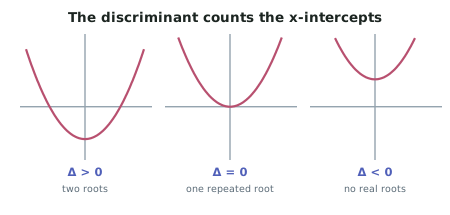
- Note the vocabulary. "Two distinct real roots" means ; "equal roots", "a repeated root" or "a double root" all mean ; "no real roots" means .
- At Level 2, means there are no real solutions and you stop there. Complex roots are Level 3.
Why it works
- The quadratic formula is .
- If , the square root is a real number and the produces two different answers.
- If , the root is 0 and gives the same answer twice.
- If , the square root of a negative number is not real, so there are no real solutions.
The graphical meaning
-
The roots of are the -intercepts of the parabola .
-
therefore counts the crossings, and this is often the fastest way to interpret a question about a curve and a line.
-
A tangent means a repeated root. If a line just touches a parabola, substituting one into the other gives a quadratic with . That connection turns geometry questions into discriminant questions.
Questions with an unknown constant
-
The characteristic Merit/Excellence form: "find the values of for which has equal roots".
- Write the discriminant in terms of .
- Apply the condition (, or ).
- Solve the resulting equation or inequality.
-
Worked through:
- Equal roots means : , so
- Both values. A squared unknown gives two answers.
-
If the condition is an inequality, the answer is a range.
- "Two distinct real roots" gives , so or .
- "No real roots" gives , so .
-
Note how the two answers differ in shape: splits into two separate intervals, while is a single interval between the roots. Sketching makes the difference obvious.
Watch for a hidden rearrangement
- The discriminant applies only in the form .
- If the question gives , rearrange first: , and then , not .
The 2025 report
- "Used the discriminant to solve problems" is listed as a Merit behaviour, and "linked the discriminant to a problem and substituted to find both values" as Excellence.
- Meanwhile Not Achieved candidates "displayed little understanding of the process for completing the square, theories relating to the discriminant, or quadratic formulae".
Worked ExampleA tangency condition
The line is a tangent to the parabola . Find the value of and the coordinates of the point of contact.
Step 1 — Recognise what "tangent" means algebraically
A tangent touches the curve at exactly one point. So the equation formed by setting them equal must have exactly one solution — a repeated root — which means:
Step 2 — Set the two expressions equal
Where the line meets the curve, their -values agree:
Step 3 — Rearrange to standard form
Move everything to the left so the right-hand side is zero:
Step 4 — Identify the coefficients
Note that contains the unknown, which is what makes the equation solvable for .
Step 5 — Write the discriminant
Step 6 — Apply the tangency condition
Step 7 — Find the point of contact
Substitute back into the rearranged quadratic:
The repeated root confirms a single point of contact ✓
Find using the line (either equation works, and agreement is a check):
Check with the parabola:
Both give , confirming the point lies on both graphs.