McGregor's Theory X and Y, and Vroom's expectancy theory
McGregor: Theory X and Theory Y
Douglas McGregor argued that managers hold one of two sets of assumptions about their staff, and that the assumption shapes the management style, which then shapes the behaviour.
Theory X — the manager assumes:
- People dislike work and avoid it where they can
- They must be directed, controlled and threatened with penalties to put in effort
- They avoid responsibility, have little ambition, and want security above all
- Resulting style: close supervision, detailed instructions, tight control, discipline-based
Theory Y — the manager assumes:
- Work is as natural as rest or play
- People will direct themselves towards objectives they are committed to
- They seek responsibility, and are capable of imagination and ingenuity
- Commitment follows from the rewards associated with achievement
- Resulting style: delegation, participation, autonomy, development
Why it matters — the self-fulfilling loop
- The theories are not descriptions of two types of worker. They are descriptions of two types of manager, and each produces the behaviour it expects:
- A Theory X manager supervises closely and removes discretion → staff have no opportunity to show initiative and stop offering it → the manager observes passive staff and concludes Theory X was correct.
- A Theory Y manager delegates and trusts → staff take responsibility and develop → the manager observes capable staff and concludes Theory Y was correct.
- This is why McGregor is so useful in an investigation: you can often see the loop running in a real workplace.
The honest qualification. Theory Y is not automatically right. New, untrained or seasonal staff genuinely need direction, and safety-critical work needs prescribed procedure. The failure is applying Theory X to people who have outgrown it — which is the exact complaint experienced staff make about close supervision.
Vroom: expectancy theory
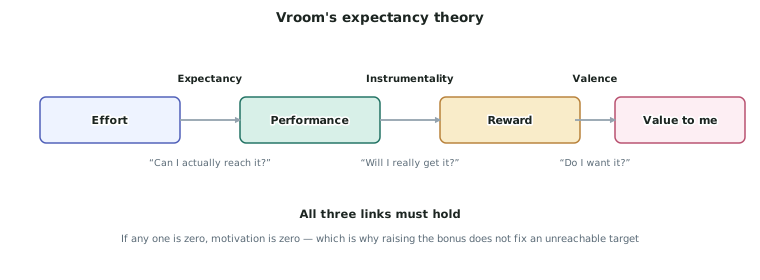
Victor Vroom argued that motivation depends on a person's calculation, not their needs. A person is motivated when three conditions hold at once:
- Expectancy — "If I put in the effort, will I actually achieve the performance?"
- Depends on skill, training, tools and whether the target is realistic.
- Instrumentality — "If I achieve it, will I actually get the reward that was promised?"
- Depends entirely on whether the business has kept its promises before.
- Valence — "Do I actually want that reward?"
- A reward the employee does not value produces no motivation at all.
Vroom expressed it as a chain: motivation requires all three. If any one is zero, motivation is zero.
Why this is practical. It explains exactly why incentive schemes fail:
| Broken link | What it looks like | The fix |
|---|---|---|
| Expectancy | The target is unreachable, or staff lack the training or equipment to hit it | Set achievable targets; train; fix the equipment |
| Instrumentality | The bonus was not paid last time, or the rules changed after the fact | Pay what was promised, transparently and on time |
| Valence | The reward is a voucher for something the employee does not want | Ask people what they value; offer a choice |
Using both in an investigation
- McGregor explains the management style you observe — how supervisors behave, and how staff respond to it.
- Vroom explains why a specific scheme does or does not work — and it is the sharpest diagnostic tool available, because it gives you three testable questions to ask staff:
- Do you think you can reach the target?
- If you reach it, do you believe you will get the reward?
- Do you want the reward?