Herzberg's two-factor theory
The theory
- Frederick Herzberg asked employees to describe times they felt exceptionally good and exceptionally bad about their jobs.
- The two lists were different, not opposites. The things that made people satisfied were not the absence of the things that made them dissatisfied.
- He concluded there are two separate factors:
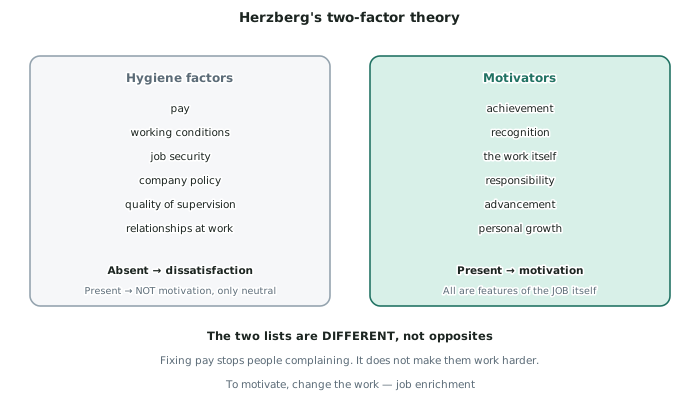
Hygiene factors (also called maintenance factors)
- Pay, working conditions, job security, company policy, quality of supervision, relationships with colleagues.
- Their absence causes dissatisfaction. Their presence does not cause motivation — it merely removes the dissatisfaction.
- Getting them right takes the workforce to neutral, not to motivated.
Motivators
- Achievement, recognition, the work itself, responsibility, advancement, personal growth.
- These are what actually motivate. They are all features of the job, not of the conditions around it.
What it predicts
- Fixing pay will stop people complaining and will not make them work harder. This is the theory's most useful and most counter-intuitive claim.
- A business that responds to a motivation problem with a pay rise has treated a hygiene factor and will see the dissatisfaction return.
- The route to motivation is job enrichment — redesigning the work so it contains achievement, responsibility and growth.
- Satisfaction and dissatisfaction are not on one scale: an employee can be simultaneously not dissatisfied (good pay and conditions) and not motivated (boring work).
Applying it to a business
- First, fix the hygiene factors. Fair pay, safe conditions, competent supervision, clear policies. If these are wrong, nothing else will work.
- Then build in motivators through job design:
- Achievement — give people whole pieces of work with a visible result
- Recognition — specific, timely acknowledgement of good work
- The work itself — variety and interest
- Responsibility — authority to make decisions about their own work
- Advancement and growth — training, and a visible path
Criticisms
- The original study used accountants and engineers — professionals with secure, interesting work — and the findings may not transfer to routine or insecure jobs.
- People tend to attribute good outcomes to themselves (achievement) and bad ones to their circumstances (pay, the boss), which may explain the two lists.
- Pay is not purely hygiene: for people on low incomes, and where pay is a form of recognition, it clearly motivates.