Maslow's hierarchy of needs
The theory
- Abraham Maslow argued that human needs fall into a hierarchy, and that a person is motivated by the lowest level not yet satisfied.
- Once a level is largely met, it stops motivating, and attention moves up to the next.
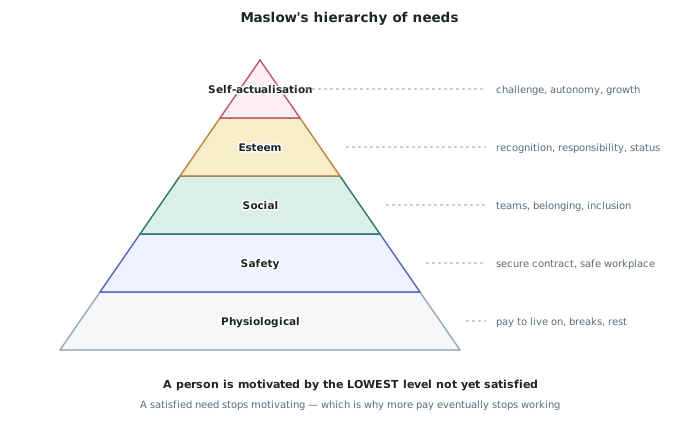
| Level | The need | What meets it at work |
|---|---|---|
| 1. Physiological | Food, water, warmth, rest | Pay high enough to live on; breaks; safe temperature; somewhere to eat |
| 2. Safety | Security, stability, freedom from harm | A secure contract; a safe workplace; predictable hours; fair procedures |
| 3. Social (belonging) | Relationships, acceptance, belonging | Teams, shared spaces, social events, being included and valued |
| 4. Esteem | Recognition, status, respect, achievement | Praise, job titles, responsibility, awards, being asked for an opinion |
| 5. Self-actualisation | Fulfilling one's potential | Challenging work, creative freedom, development, autonomy |
What it predicts
- A business cannot motivate with esteem what it has failed to provide in safety. Employee-of-the-month awards mean nothing to someone whose hours are cut without notice.
- The motivator that works depends on where the workforce currently is, which is why the same technique succeeds in one business and fails in another.
- Because a met need stops motivating, a business must keep moving up the hierarchy for staff who have been there a long time — the reason experienced employees need enrichment rather than another pay rise.
Applying it to a business
- Identify the level the business's practices actually target:
- Pay and conditions → levels 1 and 2
- Teams and social events → level 3
- Recognition and responsibility → level 4
- Development, autonomy, challenge → level 5
- Then ask whether the levels below it are secure. A gap lower down explains most failed motivation schemes.
Criticisms — worth knowing for the evaluation
- People do not move through the levels in a strict order; someone may pursue esteem while their job security is poor.
- The levels mean different things in different cultures. Maslow's hierarchy is built around individual fulfilment, whereas in a business grounded in whanaungatanga belonging and collective standing may matter more than individual esteem — so the model's top levels do not translate straightforwardly.
- Needs cannot be measured, so the theory is difficult to test.