Sampling methods
Why sampling decides everything
- A population is everyone the research is about — all students at the school, all customers of the café, all households in the suburb.
- A sample is the part of that population you actually collect data from, because surveying everyone is impossible.
- The sample is the single biggest threat to validity. If the sample does not represent the population, the findings describe the sample and nothing else — however many people you asked and however good your questions were.
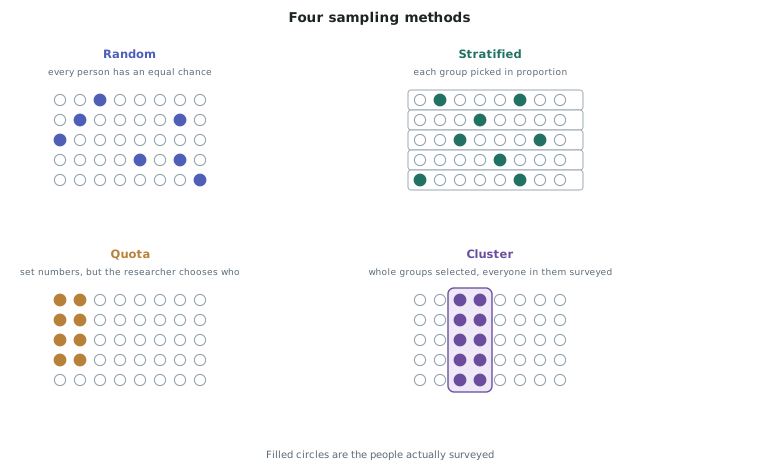
The four methods
Random sampling
- Every member of the population has an equal chance of being selected — for example numbering the whole school roll and using a random number generator.
- Advantages: free of researcher bias; statistically the most defensible.
- Disadvantages: you need a full list of the population; the people selected may be hard to reach; a small random sample can still miss a group by chance.
Stratified sampling
- The population is divided into strata (groups that matter — year level, age band, department), and people are selected from each stratum in proportion to its share of the population.
- If Year 9 is 25% of the roll, Year 9 is 25% of the sample.
- Advantages: guarantees every relevant group is represented in the right proportion; the most accurate of the practical methods.
- Disadvantages: you need to know the population's composition beforehand — which is exactly what secondary data provides; more work to organise.
Quota sampling
- The researcher decides how many people to survey from each category — 20 Year 9s, 20 Year 10s — and then surveys whoever they can find until each quota is filled.
- Advantages: fast, cheap, and no population list is needed; ensures each group appears.
- Disadvantages: not random, because the researcher chooses who to approach, so bias creeps in — approachable people are over-represented.
Cluster sampling
- The population is divided into clusters (whole classes, whole suburbs, whole stores), a number of clusters are selected, and everyone inside the selected clusters is surveyed.
- Advantages: very efficient when the population is spread out; no full list of individuals needed.
- Disadvantages: people within a cluster tend to be similar, so the sample is less varied than its size suggests — three classes of Year 12 students are not a cross-section of a school.
Sample size
- Larger samples reduce the effect of unusual individual answers, but a large biased sample is worse than a small unbiased one — it is confidently wrong.
- The standard asks for sufficient primary data of adequate quantity and quality. For a school-based project that usually means tens rather than hundreds, but it must be enough that one unusual respondent cannot move your conclusion.
- Report the response rate, not just the number returned: 40 responses from 50 handed out is a much stronger result than 40 from 400.
The bias to watch for
- Convenience bias — surveying whoever is nearby. Surveying at the canteen queue at lunchtime samples people who already buy lunch, which will overstate demand for a lunch product.
- Self-selection bias — only people who care enough to respond do so, and they are usually the most enthusiastic or the most annoyed.
- Time and place bias — a Friday afternoon sample is different from a Monday morning one.