What the standard requires
The activity
- A business activity is defined by the standard as the production of a good or service. You are producing something and taking it to market, not organising an event for its own sake.
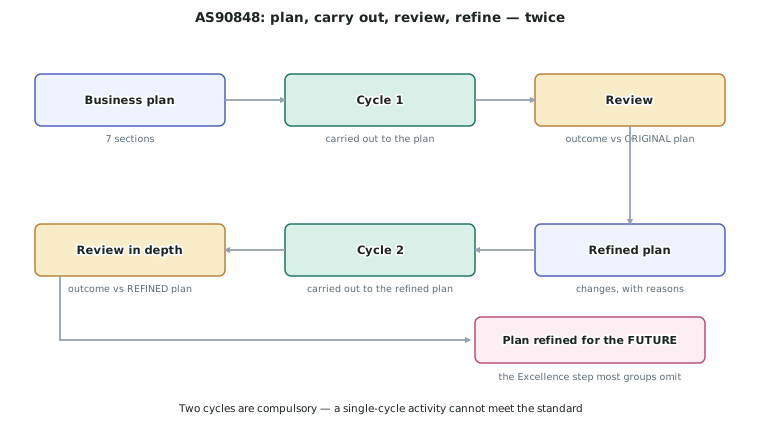
- It must run for at least two cycles, with the plan refined between them. This is not optional — the whole structure of the standard is the loop.
- It is carried out with guidance, which the standard defines as teacher assistance on the activity and on its ethical aspects. Guidance is expected; it does not reduce your grade.
The community context — the requirement people misread
- The activity must have a community well-being focus and must operate in the wider community.
- Well-being is defined precisely: improving the social, mental or physical health of a community, or improving community cohesion.
- So the community element is not a decoration on a business activity. It is the purpose the activity is designed around.
What counts as a community context (from the teaching guide):
- providing a service to the community or part of it
- sponsoring, fundraising or donating profit or products to a community group, activity or non-profit organisation
- creating an awareness campaign for a local community group
Communities the guide names: schools, churches, kōhanga reo and marae, youth organisations, retirement villages, sports clubs, local councils including parks and recreation, environmental groups, and local branches of non-profit organisations.
Two mistakes to avoid at the planning stage
Mistake one — an activity with no community well-being focus.
- Selling drinks at a school event to make a profit for the class is a business activity, but the community element is missing and the standard cannot be met.
- Adding "we will donate the profit" at the end does not fix it, because the well-being focus has to shape what the activity is and who it serves.
Mistake two — a community project that is not a business activity.
- Running a clean-up day is community service, but nothing is produced and taken to market, so there is no business to plan, cost, market or review.
- The standard needs both: a good or service, produced and sold or delivered, with a community well-being purpose.
Choosing an activity that will work
Test any idea against six questions before committing:
- Is a good or service actually produced?
- Whose well-being does it improve, and how? Name the community and the social, mental or physical health outcome, or the cohesion it builds.
- Can it run twice? The activity must be repeatable within your timeframe. A one-off event with a fixed date cannot give you two cycles.
- Can you afford the first cycle? Something has to be paid for before any revenue arrives.
- Is it legal and safe, and have you the permissions? Food handling, site access, and school and council approvals all take time.
- Is it ethical? The standard makes ethics an explicit part of the guidance — how you source, price, and treat the people involved.
Working with the community group
- If you are working with an organisation — a marae, a sports club, a retirement village, a food bank — talk to them before the plan is finalised. What they need is often not what a group of students assumes they need.
- Agree at the start what they will receive, when, and what they are committing to provide. Vagueness here is the most common cause of a difficult second cycle.
- Where the activity involves a marae, a kōhanga reo or an iwi organisation, follow their tikanga: ask about protocols rather than assuming, and treat the relationship as the point rather than the paperwork. Whanaungatanga — building and sustaining the relationship — is what makes the second cycle possible at all.