Changes in skull and endocranial features
The overall trend
- Two changes dominate, and they are linked:
- The braincase enlarged.
- The face and jaws reduced.
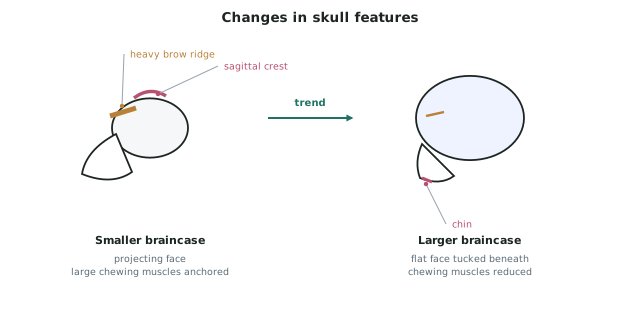
- The result is a skull with a large, rounded cranium above a small, flat face, replacing a small braincase behind a large projecting face.
Cranial capacity
- Cranial capacity is the internal volume of the braincase, measured in cm3, and it is used as a proxy for brain size.
- The trend over roughly 4 million years is a large increase:
| Group | Approximate cranial capacity |
|---|---|
| Living chimpanzee | ~400 cm3 |
| Early bipedal hominins (australopiths) | ~400–500 cm3 |
| Early Homo | ~600–750 cm3 |
| Homo erectus | ~900–1100 cm3 |
| Modern Homo sapiens | ~1350 cm3 average |
- Two cautions that gain credit:
- The increase was not steady. It was slow for millions of years, then comparatively rapid within Homo.
- Absolute size is not the whole story. Brain size scales with body size, so relative brain size, and the proportions of different regions, matter as well.
Changes in the face and jaws
- Prognathism — the forward projection of the face and jaws — decreased, so the face became flatter and tucked beneath the braincase.
- Teeth became smaller, particularly the canines and the chewing teeth, and enamel thickness changed with diet.
- The dental arcade — the arrangement of the tooth rows — changed from a U-shape with parallel rows in apes to a rounded parabolic arch in humans.
- A chin developed on the lower jaw. This is unique to Homo sapiens and is a useful diagnostic feature.
Changes in muscle attachments
-
These follow directly from the two trends above, and explaining the link is what lifts an answer to Merit:
- Brow ridges (supraorbital tori) — heavy in apes and early hominins, reduced in modern humans. They buttress the face against chewing forces, so smaller chewing forces mean less buttressing is needed.
- Sagittal crest — a ridge along the top of the skull anchoring large chewing muscles. Present in some apes and in robust australopiths; absent in Homo. As chewing muscles reduced, the crest was no longer needed to anchor them.
- Nuchal crest — a ridge at the back of the skull anchoring neck muscles. Reduced in hominins, because a skull balanced on top of the spine needs far less muscular effort to hold up.
-
So reduced crests are not simply "more modern-looking". They are consequences of reduced chewing forces and upright head balance.
Why the face and jaws reduced
- The trend tracks a change in diet and food processing:
- Softer, higher-quality diet. More meat and more processed plant food require less prolonged, forceful chewing than tough fibrous vegetation.
- Tools did some chewing work externally — cutting, pounding and slicing food before it entered the mouth.
- Cooking, once fire was controlled, softens food and breaks down starch and protein, greatly reducing the mechanical work of chewing and increasing the energy obtained.
- With chewing forces reduced, large teeth, heavy jaws and the crests anchoring the chewing muscles were no longer maintained by selection. Building and carrying them costs energy, so individuals investing less in them had more energy available for other functions.
Endocranial features
- Endocranial features are those of the inside of the braincase. An endocast — a cast of the internal surface, natural or made from a fossil — preserves impressions of the brain's outer surface.
- What endocasts can show:
- Overall volume and shape, including which regions expanded.
- Asymmetry between the left and right hemispheres, which in modern humans relates to handedness and language.
- Impressions in the regions associated with speech production and language comprehension, which are enlarged in humans compared with apes.
- Their limitations must be stated: an endocast records only the outer surface, gives no information about internal structure, cell numbers or connections, and impressions are often faint and disputed. Inferring language from an endocast is therefore an interpretation, not a direct observation.
Why brain expansion was favoured
- The brain is metabolically very expensive — in modern humans it is about 2% of body mass but uses roughly 20% of resting energy. So a large brain must deliver a large benefit, and it must be affordable.
- Hypotheses, all supported to some degree and not mutually exclusive:
- Diet quality. Meat and cooked food are far more energy-dense than raw fibrous plant material, making a costly brain affordable. Reduced gut size, possible on a high-quality diet, frees further energy.
- Social complexity. Living in larger groups requires tracking relationships, cooperation and competition — cognitively demanding, and rewarded with better access to food and mates.
- Tool manufacture. Making and using tools requires planning, sequencing and learning.
- Environmental variability. Fluctuating climates favour behavioural flexibility over fixed responses, since learning can adjust within a lifetime where evolution cannot.
Selective advantage
- Reduced jaws and teeth. Bone, muscle and enamel are costly to build and maintain. Once tools and cooking reduced the chewing required, individuals investing less in the chewing apparatus had more energy for other functions, including reproduction, with no loss of feeding ability.
- Larger brain. Better learning, planning, tool use and social coordination improve food acquisition and survival, and allow behaviour to be adjusted within a lifetime rather than across generations. The advantage must exceed the very high energy cost, which is why brain expansion follows improvements in diet quality.
Worked Example
Worked Example
Three fossil skulls are compared.
| Feature | Skull X (2.5 My) | Skull Y (1.5 My) | Skull Z (0.05 My) |
|---|---|---|---|
| Cranial capacity | 480 cm3 | 950 cm3 | 1400 cm3 |
| Prognathism | Marked | Moderate | Slight |
| Brow ridges | Very heavy | Heavy | Slight |
| Sagittal crest | Present | Absent | Absent |
| Molar surface area | Very large | Moderate | Small |
| Chin | Absent | Absent | Present |
Stone tools are found with Y and Z. Charred bone and ash are found with Z only.
Describe the trends, explain why they occurred, and evaluate what can be concluded.
Answer:
The trends.
Two opposing trends run through the sequence:
- The braincase enlarged, from 480 to 1400 cm3 — roughly a three-fold increase.
- The face and chewing apparatus reduced: prognathism went from marked to slight, brow ridges from very heavy to slight, molar surface area from very large to small, and the sagittal crest was lost between X and Y.
A chin appears only in skull Z, which is consistent with it being Homo sapiens, since a chin is unique to our species.
Why the chewing apparatus reduced.
The reduction is explained by a fall in the mechanical work of chewing, and the archaeology supplies the mechanism.
- Skull X has very large molars and a sagittal crest. A sagittal crest anchors large temporalis chewing muscles, and heavy brow ridges buttress the face against the forces those muscles generate. Both indicate a diet requiring prolonged, forceful chewing — tough, fibrous plant material.
- Stone tools appear with Y. Tools do chewing work outside the mouth — cutting, slicing and pounding food before it is eaten. Less force is then needed from the jaws. Consistent with this, the sagittal crest is absent in Y and molar area has fallen.
- Charred bone and ash appear with Z, indicating fire and probably cooking. Cooking softens food and breaks down starch and protein, further reducing chewing work and increasing the energy extracted. Z has the smallest molars and only slight brow ridges.
Once chewing forces fell, large teeth, heavy jaws and the crests anchoring the muscles were no longer maintained by selection. They are costly to build and carry, so individuals investing less in them had more energy for other functions with no loss of feeding ability, and the alleles for reduced structures increased in frequency.
Why the braincase enlarged.
Brain tissue is metabolically expensive — in modern humans about 2% of body mass but roughly 20% of resting energy — so expansion requires both a benefit and the energy to pay for it.
- The benefit: better learning, planning and social coordination improve food acquisition and survival, and allow behaviour to be adjusted within a lifetime.
- The energy: tools and later cooking provided a higher-quality, more energy-dense diet. This is what made a larger brain affordable.
Note that the two trends are therefore linked, not independent. The same innovations — tools, then fire — reduced the need for a heavy chewing apparatus and supplied the surplus energy that a larger brain required.
Evaluating what can be concluded.
Well supported:
- The direction of both trends is clear and consistent across the three skulls.
- The association between the appearance of tools and fire and the reduction in chewing apparatus is strong, and the mechanism linking them is well understood.
Less secure, and worth stating:
- Three skulls are not a lineage. X, Y and Z may be side branches rather than a direct ancestor–descendant sequence. The trend in the group over time is supported; direct descent is not.
- Each skull is one individual. Cranial capacity varies substantially within any population, so single specimens cannot establish population means. A larger sample would be needed.
- Association is not causation. Tools and fire coincide with the anatomical changes, but other factors — climate, habitat, social structure — changed over the same period and cannot be excluded.
- Absence of evidence is weak. Tools are absent with X, but wooden or bone tools rarely preserve, so we cannot conclude X used none.
How the conclusion could be strengthened. More specimens from each period; microwear analysis of the tooth surfaces to show directly what was being eaten; and independent evidence of habitat and climate from the same deposits.