Changes in the manipulative ability of the hand
Why the hand is a separate trend
- The standard lists changes in the manipulative ability of the hand as one of the three biological trends, alongside bipedalism and skull changes.
- It follows from bipedalism: once the forelimbs were no longer needed for locomotion, they were free to be modified for manipulation rather than for supporting body weight and climbing.
Two kinds of grip
-
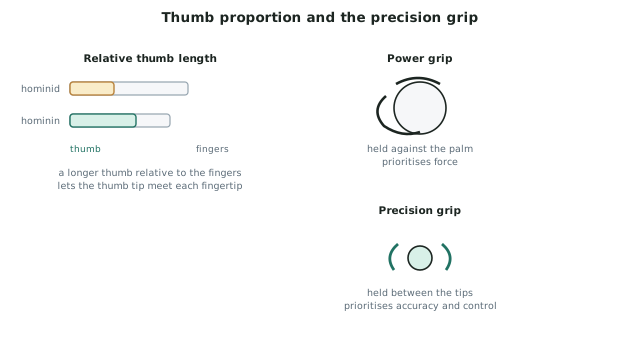
Power grip — the object is held against the palm with the fingers wrapped around it, and the thumb reinforces. Used for strength: gripping a branch, swinging a heavy tool.
-
Precision grip — the object is held between the tips of the thumb and one or more fingers, with fine control and no contact with the palm. Used for accuracy and fine manipulation: turning a small object, striking a stone flake at a precise angle.
-
Apes have a strong power grip but a limited precision grip. Humans have both, and the trend in hominin evolution is toward a greatly improved precision grip without losing the power grip entirely.
The anatomical changes
- Relative thumb length increased.
- In apes the thumb is short relative to the long fingers, so the thumb tip cannot easily meet the fingertips.
- In hominins the thumb is longer relative to the fingers, so the thumb tip can be brought against each fingertip — full opposability in a functional sense.
- The thumb became more mobile, with joint surfaces at its base — the carpometacarpal joint — allowing rotation as well as flexion.
- Thumb muscles enlarged, particularly those that pull the thumb across the palm and rotate it, giving the force needed for a firm precision grip rather than merely a delicate one.
- Fingers became shorter and straighter.
- Ape fingers are long and curved, which is efficient for hooking onto branches but poor for fine manipulation.
- Reduced curvature indicates reduced arboreal locomotion and is used as evidence of a more terrestrial lifestyle.
- Fingertips broadened, with wider terminal phalanges supporting broader, more sensitive pads. This increases the contact area and the tactile sensitivity available for controlling an object.
- The wrist changed to allow the hand to be held in a stable position and to transmit force without injury during forceful precision tasks such as striking stone.
Reading hands in the fossil record
- Hand bones are small and fragile, so they preserve poorly and complete fossil hands are rare. Much interpretation rests on isolated bones, which is a real limitation.
- Evidence used:
- Bone proportions, especially thumb length relative to finger length.
- Joint surface shapes, which indicate the range and type of movement possible.
- Muscle attachment sites, whose size indicates how large the attached muscles were.
- Finger curvature, indicating how much climbing the individual did.
- Some fossil hominins show a mosaic — hand features indicating good manipulation alongside curved fingers indicating continued climbing. This is important evidence that the trends were not a neat sequence, and that species could combine features we might expect to be separated.
Why improved manipulation was favoured
- Tool manufacture, not just tool use. Several animals use tools; consistently making them to a pattern requires controlled, repeated, accurate strikes, which requires a firm precision grip.
- Tool use improved food access — cutting meat from carcasses, breaking bones for marrow, digging tubers, processing plants. Each increases the energy obtained and widens the range of foods available.
- Better food processing contributed to the dietary improvement that made brain expansion affordable, linking this trend to the others.
- The relationship with cognition is reciprocal: making better tools requires planning and learning, and improved cognition permits more complex tools. Neither is simply the cause of the other.
Selective advantage
- An individual able to make and use better tools obtained more food per unit of foraging effort — more meat from a carcass, access to marrow and buried tubers that others could not reach.
- More energy assimilated means more available for growth and reproduction, and access to a wider range of foods buffers against seasonal shortage, improving survival in lean periods.
- Because hand anatomy is heritable, individuals whose hands allowed more effective tool manufacture left more surviving offspring, and the alleles increased in frequency.
Worked Example
Worked Example
A fossil hand is recovered in association with sharp-edged stone flakes and animal bones bearing cut marks.
- The thumb is long relative to the fingers, similar to the modern human proportion.
- Muscle attachment sites on the thumb are large.
- The finger bones are curved, more so than in modern humans but less than in a chimpanzee.
- The fingertip bones are broad.
Explain what this hand could do, and evaluate what can be concluded about the species' behaviour.
Answer:
What the hand could do.
The features indicate a hand capable of a firm precision grip:
- A long thumb relative to the fingers means the thumb tip can be brought against the fingertips, which is what allows an object to be held between tips rather than against the palm.
- Large muscle attachment sites indicate powerful thumb muscles. This matters because it distinguishes a firm precision grip, capable of resisting force, from a merely delicate one — you cannot strike stone accurately with a weak grip.
- Broad fingertip bones support broad, sensitive pads, increasing contact area and tactile feedback for controlling an object.
Together these indicate the hand could grip a stone firmly between thumb and fingers and control it accurately under force — precisely what is required for making stone tools.
What the curved fingers indicate.
The fingers are curved, more than in modern humans but less than in a chimpanzee. Curved phalanges are associated with hooking onto branches, so this indicates the species was still climbing regularly, though less than a chimpanzee.
This is a mosaic of features — a derived, manipulative thumb combined with a retained, more arboreal finger form. It shows the species was doing both things, and it is a reminder that trends do not proceed as tidy sequences with one feature completed before the next begins.
What the associated evidence adds.
The cut-marked bones are the strongest evidence, and they are independent of the anatomy:
- Cut marks are made by a sharp edge drawn across bone while removing flesh.
- Their presence shows that stone tools were actually used to process animal tissue at this site — not merely that the hand was capable of it.
- The sharp-edged flakes found with them provide the plausible tool.
The anatomical evidence shows capability; the archaeological evidence shows behaviour. Neither alone would establish both.
Evaluating the conclusion.
Well supported:
- That the hand was capable of a firm precision grip. This follows directly from the bone proportions and muscle attachments.
- That stone tools were used on animal tissue at this site, from the cut marks.
- That the species retained some climbing ability, from the finger curvature.
Less secure, and worth stating:
- Association is not attribution. The hand and the tools were found together, but that does not prove this individual made or used them. Another hominin species could have been responsible, and more than one species is known from some deposits. Establishing who made tools from co-occurrence alone is a recognised difficulty.
- Capability is not proof of practice. A hand able to make tools may not have done so. The cut marks show tools were used at the site; the hand shows it could have. Linking the two requires the association to be genuine.
- One specimen is limited. Hand bones preserve poorly and complete fossil hands are rare, so conclusions often rest on few individuals and cannot show variation within the species.
How the conclusion could be strengthened. More hand specimens; deposits where only one hominin species is present, removing the attribution problem; and microwear on the flakes themselves showing what they were used on.