Bipedalism: skeletal changes
Hominins and hominids
-
Hominids are the family that includes humans and the great apes — chimpanzees, gorillas and orangutans.
-
Hominins are the subgroup of hominids belonging to the human lineage — living humans and all fossil species more closely related to us than to chimpanzees.
-
So every hominin is a hominid, but not every hominid is a hominin.
-
The standard begins with early bipedal hominins, and comparisons are made with living hominids — usually the chimpanzee, as a model of an ape skeleton rather than as an ancestor.
-
Chimpanzees are not our ancestors. They are our closest living relatives, and both lineages have been evolving since they diverged. Saying humans "evolved from chimpanzees" is wrong and is penalised.
Bipedalism came first
- Bipedalism is habitual upright walking on two legs.
- The fossil evidence shows bipedal hominins existed by around 4 million years ago, and possibly earlier, while substantial brain expansion did not begin until around 2 million years ago.
- So the sequence is bipedalism first, large brains later — by a margin of millions of years. This ordering matters, because it rules out explanations in which walking upright was a consequence of intelligence.
The skeletal changes
Every change below solves the same mechanical problem: balancing and supporting the whole body mass on two legs, rather than distributing it across four limbs.
-
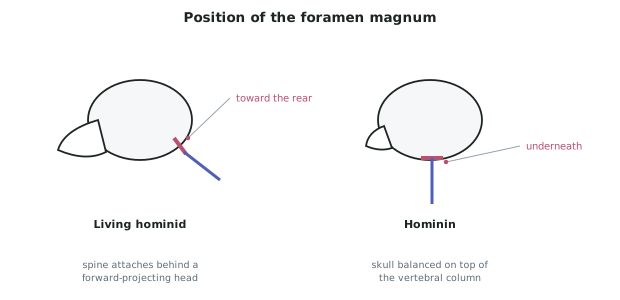
Position of the foramen magnum — the hole where the spinal cord enters the skull.
- Ape: positioned toward the rear of the skull, because the spine attaches behind a forward-projecting head.
- Hominin: positioned underneath, near the centre, so the skull is balanced on top of the vertebral column.
- This means far less neck muscle is needed to hold the head up, and it is one of the most reliable indicators of bipedalism in a fossil skull.
-
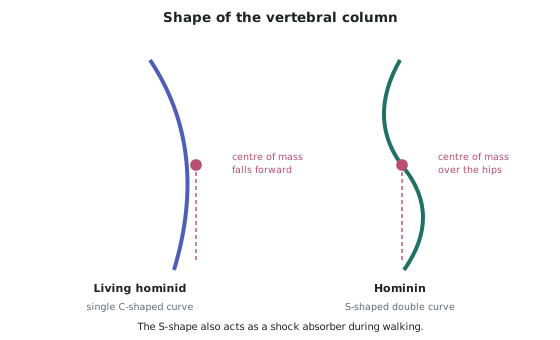
Shape of the vertebral column.
- Ape: a single C-shaped curve.
- Hominin: an S-shaped double curve, with curves in the neck and lower back.
- The S-shape acts as a shock absorber and positions the body's centre of mass over the hips and feet.
-
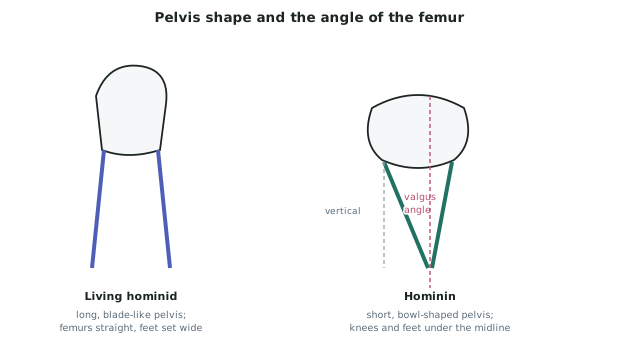
Shape of the pelvis.
- Ape: long, flat, blade-like ilium, oriented backwards.
- Hominin: short, broad and bowl-shaped, curving around the sides.
- This does three things: it supports the abdominal organs from below, it brings the gluteal muscles to the side of the hip so they can stabilise the trunk over the standing leg, and it lowers the centre of mass.
-
Angle of the femur (the valgus or carrying angle).
- Ape: femurs run roughly straight down from a wide pelvis, so the feet are set wide apart.
- Hominin: femurs angle inwards from hip to knee, bringing the knees and feet under the body's midline.
- This means the body's weight passes close to the midline with each step, so there is far less side-to-side sway and walking costs less energy.
-
The knee.
- Larger condyles to spread the greater load, and the ability to lock straight, so standing requires little muscular effort.
-
The foot.
- Ape: an opposable big toe that can grasp branches; a flat, flexible foot.
- Hominin: the big toe is aligned with the others (non-opposable), and the foot has longitudinal and transverse arches.
- The arches act as springs, absorbing impact and returning energy at push-off. The aligned big toe provides the final push-off thrust.
- The trade-off is that the foot can no longer grasp, so climbing ability is greatly reduced.
Why bipedalism was favoured
-
No single explanation is settled, and saying so is credited. Several hypotheses are supported by evidence, and they are not mutually exclusive:
- Freeing the hands. Walking on two legs leaves the hands available to carry food, infants and tools. Carrying food to a shared site allows provisioning of offspring and others.
- Energy efficiency. Human walking is more energetically efficient over long distances than ape knuckle-walking. In an environment where food is patchy and widely spaced, covering distance cheaply is a large advantage.
- Thermoregulation. Standing upright reduces the body surface exposed to overhead sun and raises more of the body into cooler moving air, reducing heat load in open habitat.
- Visibility. Greater height improves the ability to see over vegetation, detecting predators and food.
-
The environmental context is habitat change — a long-term trend toward more open woodland and grassland in Africa — which would favour efficient ground travel between scattered resources over movement through continuous canopy.
Selective advantage
- Each change is advantageous because it reduces the energy cost or injury risk of upright locomotion:
- An S-shaped spine and bowl-shaped pelvis mean the trunk is balanced rather than held up by continuous muscular effort, so less energy is spent simply standing.
- The valgus femur angle reduces side-to-side sway, so less energy is wasted moving the body sideways with each step.
- Arched feet store and return elastic energy at each stride.
- Energy saved is energy available for growth, foraging and reproduction, so individuals with these features could travel further to find food and had more resources to invest in offspring — meaning more offspring surviving, and the alleles increasing in frequency.
Worked Example
Worked Example
Two fossil pelvises and two skulls are compared with those of a living chimpanzee.
- Fossil A (dated 3.5 million years): pelvis short and bowl-shaped; foramen magnum positioned underneath the skull; cranial capacity about 450 cm3.
- Fossil B (dated 0.5 million years): pelvis short and bowl-shaped; foramen magnum underneath; cranial capacity about 1100 cm3.
- Chimpanzee: pelvis long and blade-like; foramen magnum toward the rear; cranial capacity about 400 cm3.
Explain what these data show about the sequence of trends in human evolution, and explain the selective advantage of the changes shown.
Answer:
Both fossils were bipedal.
In both A and B the pelvis is short and bowl-shaped rather than long and blade-like, and the foramen magnum is underneath the skull rather than at the rear. Both features are direct indicators of upright posture:
- A bowl-shaped pelvis supports the abdominal organs from below and positions the gluteal muscles laterally so they can stabilise the trunk over the standing leg — necessary only if the trunk is upright.
- A foramen magnum underneath the skull means the head is balanced on top of the vertebral column, which is only mechanically sensible in an upright animal.
The chimpanzee shows the contrasting condition in both features, confirming that these are genuine differences rather than variation within one body plan.
The decisive point: bipedalism preceded brain expansion.
Fossil A, at 3.5 million years, is fully bipedal but has a cranial capacity of 450 cm3 — barely larger than the chimpanzee's 400 cm3.
Fossil B, at 0.5 million years, is also bipedal but has a cranial capacity of 1100 cm3, roughly 2.4 times that of fossil A.
So over the 3 million years between the two fossils, brain size increased greatly while bipedal features were already present and essentially unchanged. Bipedalism was therefore established millions of years before substantial brain expansion.
This is important because it rules out the explanation that hominins became bipedal as a consequence of increased intelligence — at 3.5 million years the brain was still ape-sized. The trends are separate, occurred in a definite order, and had different causes.
Selective advantage of bipedalism.
The environmental context is a long-term shift toward more open woodland and grassland, where food is patchy and widely spaced.
- Energy efficiency. Upright walking is more efficient over long distances than knuckle-walking. Individuals travelling the same distance for less energy had more energy remaining for growth and reproduction, and could search a larger area before their energy budget was exhausted.
- Freed hands. Not using the forelimbs for locomotion allows carrying — food, infants, and later tools. Carrying food back to a site allows it to be shared and offspring to be provisioned, improving offspring survival.
- Thermoregulation. An upright body presents less surface to overhead sun and reaches cooler moving air, reducing heat stress and water loss when foraging in the open.
Each of these means more energy available for reproduction and better offspring survival, so individuals with more efficient bipedal anatomy left more offspring and the alleles increased in frequency.
A necessary caution. Three fossils cannot establish a single continuous lineage. Fossils A and B may be from side branches rather than a direct ancestor–descendant sequence. What the data establish securely is the order in which the two trends appeared, which does not depend on the fossils being directly related.