Bootstrap confidence intervals and making the call
The problem bootstrapping solves
- You have one sample from each population, and one estimate of the difference between their medians.
- You need to know how much that estimate would vary if you could take many samples — but you cannot go back and take more.
- Bootstrapping simulates taking more samples, using only the data you already have.
How it works
- The procedure, which the software carries out:
- Resample with replacement from your first sample, taking the same number of observations. Some values appear twice, some not at all.
- Do the same for your second sample.
- Calculate the difference in medians for that pair of resamples.
- Repeat — typically 1 000 times or more.
- The 1 000 differences form the bootstrap distribution.
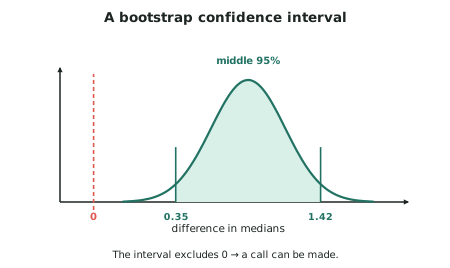
- Why resampling with replacement makes sense: your sample is the best available picture of the population, so drawing repeatedly from it mimics drawing repeatedly from the population. The spread of the bootstrap distribution estimates how much your difference-of-medians would vary between samples.
The confidence interval
- The bootstrap confidence interval is the middle 95% of the bootstrap distribution — cut off the lowest 2.5% and the highest 2.5%.
- It is reported as an interval for the difference between the population medians:
- Always state which way round the subtraction goes. An interval of means something different depending on which group was subtracted from which, and reports lose marks here routinely.
Making the call
- This is the formal inference, and the rule is simple:
| The interval | The call |
|---|---|
| Does not contain zero | A call can be made — the population medians differ, in the direction the interval shows |
| Contains zero | No call can be made — a difference of zero is a plausible value |
- Why zero is the dividing line: a difference of zero means the two population medians are the same. If zero is a plausible value for the difference, you cannot rule out that the populations are identical on this variable.
Writing the call
-
When a call can be made:
- "The bootstrap confidence interval for the difference in median sleep (Year 11 − Year 13) is 0.42 to 1.31 hours. Because this interval does not contain zero, I can make the call that back in the populations, Year 11 students tend to sleep longer than Year 13 students — by somewhere between about 25 minutes and 1 hour 19 minutes."
-
When no call can be made:
- "The interval is −0.15 to 0.87 hours. Because this interval contains zero, I cannot make a call: the evidence is not strong enough to say which population median is larger, or whether they differ at all."
-
Two things to avoid:
- Never say "there is no difference" when the interval contains zero. Say you cannot make a call. Absence of evidence is not evidence of absence, and this distinction is examined.
- Never call it "proof." A confidence interval is evidence about the populations, not certainty.
Interpreting the width of the interval
- A narrow interval means the estimate is precise — you can say not just that there is a difference, but roughly how large.
- A wide interval means the estimate is imprecise, and even a call may be of limited practical use.
- What makes the interval narrower:
- larger samples
- less variable populations
- Commenting on the width, and on what would narrow it, is a genuine reflection worth including.
Statistical against practical significance
- An interval that excludes zero says a difference exists. It does not say the difference matters.
- With very large samples, a tiny difference can produce an interval that excludes zero.
- Always ask whether the size of the difference is practically important in the context, and say so. This is exactly the integration of statistical and contextual knowledge the Excellence criterion describes.
Worked ExampleMaking a formal inference
Continuing the sleep investigation: the student bootstrapped 1 000 resamples of the difference in medians (Year 11 − Year 13) and obtained a 95% confidence interval of 0.35 to 1.42 hours.
Write the inference and the conclusion.