Experimental design principles
What makes something an experiment
- In an experiment, the researcher applies a treatment and decides who gets which one.
- In an observational study, the researcher only observes what people or things already do.
- That single difference is why experiments can support causal claims. If you allocate treatments at random, the groups start out alike in every respect — measured and unmeasured — so a difference in outcomes can be attributed to the treatment.
The vocabulary
| Term | Meaning |
|---|---|
| Experimental units | The people, animals, plants or objects the treatments are applied to |
| Treatment variable | What you change — the thing being tested |
| Treatment levels | The specific versions applied, including a control |
| Response variable | What you measure as the outcome |
| Control | A level with no treatment, or the standard treatment, for comparison |
| Replication | Applying each treatment to many units, not just one |
| Random allocation | Deciding at random which unit gets which treatment |
- Get these named explicitly in your report. The standard lists "determining treatment and response variables" and "selecting experimental units" as separate required components.
Random allocation — the heart of the design
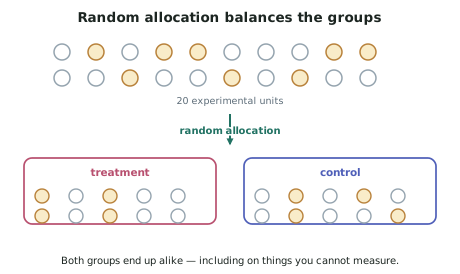
- Random allocation is not the same as random selection.
- Random selection decides who is in the study, and it determines whether you can generalise to a wider population.
- Random allocation decides who gets which treatment, and it is what allows a causal conclusion.
- What random allocation achieves: it balances all characteristics between the groups on average — including ones you never thought of and could not measure. No other technique does this.
- How to do it properly:
- Assign each unit a number.
- Use a random number generator or draw numbers from a hat.
- Allocate to groups in the resulting order.
- What does not count as random: letting people choose, allocating by which class they are in, alternating down a list, or "just mixing them up".
Sources of variation, and how to deal with them
- The Excellence criterion names this directly: discussing how possible sources of variation were dealt with during the design phase.
- There are three kinds, and each has its own remedy:
| Source | What it is | How to deal with it |
|---|---|---|
| The treatment | The effect you want to detect | This is what you are measuring |
| Known nuisance variables | Things you can identify that affect the response | Control them by holding them constant, or block on them |
| Unknown variation | Everything else, including things you cannot measure | Random allocation and replication |
- Controlling means holding a variable constant for everyone: same room, same time of day, same equipment, same instructions.
- Blocking means grouping similar units together and randomising within each block — if you know age matters, split into age bands and randomise within each.
- Random allocation handles the rest. This is the argument to make in your report: "I could control for X and Y, but I could not measure Z, so I relied on random allocation to balance it between the groups."
Other design principles
- Replication. Each treatment must be applied to enough units for the result to be more than chance. One unit per treatment tells you nothing.
- Blinding. Where possible, participants should not know which treatment they received, since expectation affects outcomes. Double-blinding — where the person measuring also does not know — removes measurement bias too.
- Standardised measurement. The response must be measured the same way for every unit: same instrument, same procedure, same person if possible.
- A control group. Without a comparison, a change cannot be attributed to anything.
Considering other relevant variables
- Before running the experiment, list the things other than your treatment that could affect the response, and say what you did about each.
- For a school experiment on, say, reaction time:
- Time of day — control it: test everyone in the same period.
- Caffeine or sleep — cannot control, so randomise and note it as a limitation.
- Practice effect — control it by giving everyone the same number of practice attempts first.
- Hand used — control by requiring everyone to use their dominant hand.
- Writing this list, with a remedy against each item, is the single most valuable page of an Excellence report.
Worked ExampleDesigning an experiment
A class wants to investigate whether listening to music with lyrics affects performance on a short memory task. There are 32 students available.
Design the experiment.
Step 1 — Pose the investigative question
Note this asks whether the treatment changes the response — a causal question, which an experiment can address.
Step 2 — Identify the components
Step 3 — Allocate treatments at random, and say how
Step 4 — Identify other sources of variation and deal with each
| Source of variation | Could it affect recall? | How it was dealt with |
|---|---|---|
| Time of day / tiredness | Yes — recall is worse when tired | Controlled: both groups tested in the same period on the same day |
| The word list | Yes — some words are easier | Controlled: the same 20-word list for everyone |
| Time allowed | Yes | Controlled: exactly 2 minutes to study, 2 minutes to recall, timed |
| Room and noise | Yes | Controlled: same room; the silence group tested with the room quiet, the music group wearing headphones |
| Volume of the music | Yes | Controlled: same track at the same volume for every student in that group |
| Instructions | Yes — different explanations could change effort | Controlled: identical written instructions read to both groups |
| Individual memory ability | Yes, strongly | Randomised: cannot be measured in advance, so random allocation balances it between the groups |
| Prior sleep, caffeine, mood | Yes | Randomised: not practical to control, relied on random allocation |
| Musical preference | Possibly — someone who dislikes the track may be more distracted | Randomised, and noted as a limitation |