What makes it an experiment
Two ways to investigate
- An observational study measures things as they are, without interfering — you watch and record.
- An experiment does something: you apply a treatment to some units and compare them with units that did not get it.
- Only a well-designed experiment can support a claim of cause and effect.
The variables
- The explanatory variable (the treatment) is the thing you change or apply — e.g. giving a fertiliser, or not.
- The response variable is what you measure to see the effect — e.g. the mass of tomatoes per plant.
- The experimental units are the things the treatment is applied to — the plants, the people, the plots.
Why an experiment can show cause, but an observation cannot
- In an observational study, the groups you compare may differ in other ways too — these are confounding variables.
- Example: if sunnier plants happened to be the ones that got fertiliser, you could not tell whether fertiliser or sunshine caused a bigger yield.
- An experiment removes this problem by using random allocation: units are split into groups by chance, so other factors are balanced out across the groups on average.
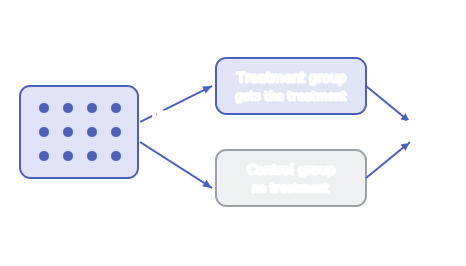
Treatment and control
- The treatment group receives the treatment.
- The control group does not — it is the baseline you compare against.
- Because allocation was random, the only systematic difference between the groups is the treatment, so a difference in the response can be attributed to the treatment.
Posing the investigative question
- The first assessed component of this standard is posing an investigative question about the experimental situation you have been given.
- A good experimental question names three things:
- the treatment being applied
- the response being measured
- the units it is being measured on
- It must be answerable by the data you are about to collect — no wider, no narrower.
- Compare these:
- Too vague: "Does fertiliser help plants?" — which fertiliser, which plants, help how?
- Not answerable: "Is this fertiliser the best on the market?" — the experiment tests one fertiliser against none, not against every competitor.
- Right: "Does applying this fertiliser change the yield of tomatoes for these 24 plants?"
- Use "change" or "affect" rather than "increase" unless you have a specific reason to predict the direction. A question that assumes the answer invites you to read the data as confirming it.
- Write the question down before collecting data, and answer that exact question in your conclusion. A conclusion that answers a different question from the one posed loses marks at both ends.
Worked ExampleIdentifying the parts of an experiment
A grower wants to know whether a new fertiliser increases tomato yield. She takes 24 similar plants, randomly assigns 12 to get the fertiliser and 12 to get none, and later weighs the tomatoes from each plant. Identify the experimental units, the explanatory variable, the response variable, and why this is an experiment.
Step 1 — Units
The experimental units are the 24 tomato plants.
Step 2 — Explanatory (treatment) variable
Whether a plant gets the fertiliser or not — this is what the grower controls.
Step 3 — Response variable
The mass of tomatoes per plant — what is measured to see the effect.
Step 4 — Why it is an experiment
The grower applies a treatment (fertiliser) and randomly allocates plants to the two groups, so it is an experiment — and any yield difference can be linked to the fertiliser rather than to some other factor.