How many trials? Why more is better
The estimate varies
- A simulation gives an estimate, not the exact probability. Run it again and you get a slightly different number — this is chance variation.
- With only a few trials, the estimate can be well off. One unlucky run of 10 trials can give a wildly wrong figure.
More trials settle the estimate
- As the number of trials grows, the running estimate stops jumping around and settles toward the true probability. This is the long-run relative frequency.
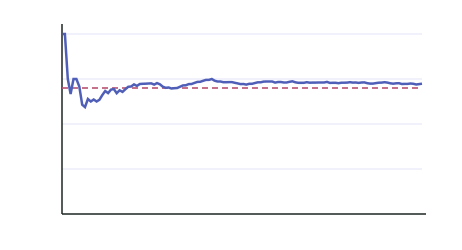
- Early on (few trials) the estimate swings widely; by several hundred trials it is close to and stable near the true value.
- This is why a good simulation uses many trials — the more you run, the more you can trust the estimate.
Comparing with theory
- If the true probability can be calculated, the simulation estimate should be close to it — and closer the more trials you run.
- A large gap has three possible causes, and naming which one applies is what the higher grades are looking for:
- too few trials — the estimate simply has not settled yet
- a design error — the random numbers were assigned in the wrong proportion, or a trial was defined wrongly
- the model does not match the situation — for example assuming each free throw is independent when a player's shots may not be
- Check the design before blaming chance. If a simulation of a fair coin settles near 0.7 after 500 trials, the problem is not luck; something in the assignment is wrong.
- Say how close is close enough. An estimate of 0.52 from 500 trials against a theoretical 0.5 is excellent agreement; a difference of 0.2 after 500 trials is not chance.
Writing the conclusion
- Answer the original question, in context and in words, not just as a number.
- State the estimate as an estimate, and say how many trials it came from: "based on 500 trials, the estimated probability is about 0.53".
- Comment on how reliable it is — more trials, more reliable — and compare with the theoretical probability if one exists.
- Name the assumptions your simulation made, and say whether they are reasonable. Every simulation assumes something: that the events are independent, that the probability stays constant, that nothing outside the model matters.
- This is where statistical insight is earned. "The simulation assumes each shot is independent with a fixed 70% chance, but a real player's chance may drop under pressure or rise once they find their rhythm, so the estimate may not reflect a real game" is the kind of reflection the standard is asking for.
Worked ExampleJudging an estimate
A student simulates a fair coin landing heads, using 10 trials, and gets 7 heads — an estimate of 0.7. They conclude the coin is biased. Is this reasonable?
Step 1 — Consider the number of trials
10 trials is very few. With so few, the estimate swings a lot — getting 7 heads out of 10 from a fair coin is entirely common.
Step 2 — What the long-run says
For a fair coin the true probability is 0.5. A running estimate would settle toward 0.5 only after many more trials; 0.7 from 10 trials is well within normal chance variation.